Here at W.C.S. We frequently try to put this advice into action, the default method of training against partner resistance is a good place to start but it is basic and if we are thinking “Schools and Education” it would fit somewhere around the late primary school level.
I have maintained for years that the Knives and the Pole are not genuine weapon systems, they are just Wing Chun weight training.
With the amount of free information available to us from people like Kelly Starrett, we are doing ourselves no favours by continually looking backwards.
When people refer to me and say ‘his Wing Chun is external, physical’, they completely miss the point. It is only our training that is physical, humans are physical beings.
What we train is what we use.
If our overriding priority is to relax, what cues are we sending to our muscles with regards to action?
Why are we training in a certain way? To have a certain outcome?
These movements are behaviours that we are trying to reinforce, practise does not make perfect, practice makes permanent.
Are we training for behaviour change, or are we only training to accomplish a task?
If it was in any way possible to create dynamic power by relaxing or moving slowly and softly why don’t Olympic weightlifters use this technique?
What are we really training to defeat? In my mind, it is the impractical silliness that is so often found in Kung Fu.
Many Wing Chun people are training relaxation, training mind power, here at W.C.S. We train to hit really hard.
“He who can handle the quickest rate of change survives.” Lt. Colonel John Boyd
The Saturday morning senior class really smacked it out of the park this week, frequently I will let the camera run through the session hoping that we will get something good, usually, it is a struggle, the pace of teaching/training is very different than the pace of presenting.
But not this week.
We were hoping to hit three topics with the same session,
understanding the O.O.D.A. Loop.
Creating distractions to facilitate the O.O.D.A. Loop.
Reverse engineering a few of our favourite moves to see where we think they come from, Forms, Chi Sau, Drills that type of stuff.
It was the third aspect that got everyone ticking, so much that I have about 90 minutes of video footage to work through.
This is just a taste, it may look a bit weird if you are not at the level of Sam, Costas and George, who are all junior master level practitioners, but the skill here is top-notch and they are trying hard not to hurt each other.
These geometric concepts of Wing Chun are presented in relatively fixed positions and shapes congruent with their respective Forms but they need to translate to all Forms
We had a great nights training on Monday, it was very theory-heavy but all the guys were up for it so it was a real eye-opener and very enjoyable as the teacher.
This post is, on the whole, a memory aid for my guys to go back and refresh their thinking because there was way too much information to take in in one evening.
Theory can be dry, and it is always tricky because only people with genuine fighting experience understand that theory and reality are in no way related, so we mixed it up with a lot of live contacts to feel the IDEA.
Of equal importance, we worked hard on creating a language to describe the work that we could all understand.
One of if not the first theory we encounter is “Centreline Theory”.
What is a centreline?
The definition of a Centreline is a line that bisects a plane.
The Wing Chun Centreline bisects the Coronal or Frontal plane of our body dividing us into left and right sides.
An imaginary line connecting ourselves to an opponent is not a centre-line, this is a common misunderstanding that leads people down the wrong path, in theory, our Centreline acts like a plane {Sagitalplane} extending forwards so it is easy to see how this confusion arises.
The use of the term Centre-line for a line from person to person is a misnomer it would be easier to grasp if we called it centre plane.
If this is confusing ask yourself “If a line from myself to my opponent is a centreline, what plane is it the centre of? What and where are the two halves”?
This may seem like a triviality but if we do not understand what a Centreline is how can we understand Centreline Theory?
This line that our perception creates that we think links us to an opponent can be anything we want it to be because it does not exist, I like to think of it as the line of mass, this IDEA can tie into other aspects of our strategy and theory.
Line of Mass is just a name we came up with on the night, if it does not work for you pick a different name, just not Centreline.
The reason I chose Line of mass is that irrespective of what type of movement is being used the opponent’s body mass follows this line, and as for ourselves, this is how we promote our body mass toward an attacker even as we appear to be avoiding an attack or moving away.
Then there is the attack- line, this is a line that runs fro the shoulder or the hip of an attacker in toward us.
An opponents attack aways finishes at a point on this line, even from a wildly swinging punch or kick, redirecting this line, and not the arm/fist/weapon using this line is the purpose of our defensive manoeuvres.
Intercepting the attack line and not the arm/leg is the most effective way to defend.
Chi Sau helps us identify and understand this and it also shows us how to create diagonal movement by the use of circular arm motion and curved arm paths.
The proximal to distal {in to out} direction of our action is always in a straight line even from a curved movement, i.e. Bong Sau travels in a straight line.
Try to not confuse straight with being parallel or perpendicular to an external reference point.
Single Arm Chi Sau essentially moves or redirects an intercepted attack-line up and down on our centre-line.
Double Arm Chi Sau moves or redirects an attack-line from the “inside gate” out to the periphery of our structure or from the outside of our structure into our centre effectively breaking both the attack-line and the line of mass of our attacker.
In a real-world application, we would combine a little of both IDEAs, for example in toward the CL and down or out away from the CL and up.
In a poorly trained person, the attack-line is rarely separated from the line of mass.
As a Wing Chun fighter on the attack, we cannot maximise our output if we do not understand the geometry and how to combine the line of mass with the attack-line while at the same time creating torque through “muscular” rotation.
These geometric concepts of Wing Chun are presented in relatively fixed positions and shapes congruent with their respective Forms but they need to translate to all Forms, all planes and directions of action, this is the heart of the work.
This is one of the principal learning objectives of Chum Ku, understanding how to support the actions {arm shapes} with our body mass as we make contact with an opponent.
Anything that makes contact with an opponent in any way, either defending or attacking creates a bridge and as such is Chum Kiu.
The following video is not the best I have ever done if you are a visitor I apologise, for us INCas it is a fairly accurate representation of what we worked on all week, I will repost it to the BODYWORK page so you can revisit easily.
“Once your opponent moves, his centre of gravity changes”.
I have said on many occasions that I am not a Wing Chun disciple, rather I am a Martial Artist that studies Wing Chun.
This allows me to explore outside of the box, allows me to step into the 21st century, embrace advances we all know are out there.
It seems to me that the average Wing Chun student would rather go backward than forward, new IDEAs are looked at as blasphemy, as a result, there is not a great deal of love for boat-rockers.
A great deal of this discord stems from the fact that we have no “Official Bible”, the closest we have is the Kuen Kuit, and even this gets translated differently by different lineages with different agendas, and now there is “Internal Wing Chun” yet another pointless bifurcation that does nothing but muddy the water.
Like it or not the only link back to the old ones is the Kuen Kuit.
Here is as good a song to sing as any others…
“Once your opponent moves, his centre of gravity changes”.
This is obviously correct and well noted because once any Human Being moves, their centre of gravity changes.
Even a Wing Chun Man.
It is up to us if this works for us or against us.
If you always do what you have always done…. yada, yada, yada.
I was talking with my guys on Monday evening about this thing we do, when we started discussing Forms everyone was on a different page, no biggy we all come from a different place for different reasons, but we did need common ground to progress.
Everything we do in my school relates to fighting, so that is always our cue.
Fighting is really easy, we just hit someone before they can hit us.
The tricky bit is developing the skill set to do this consistently and at will.
This aspect is called training, and central to most Martial Arts training are Forms {or Kata}.
Forms are a physical manifestation of the concepts that govern our chosen style{ for us Wing Chun}, they are an accessible way to explore the concepts that govern our style {Wing Chun}.
At their heart Forms are just patterns, no more no less, on some level, they are even posturing patterns designed to impress potential mates or intimidate opponents.
On your next visit to the training hall look around, many students doing Forms are just Peacocking, sending out subliminal messages about how well they move and how dangerous they look starring themselves down in the mirror.
“I will be too busy looking good”… Jim Kelly, Enter the Dragon. 1973.
Then it gets a little weird when we experience the segment of the Martial Arts community {Fecking YouTubers} that thinks Forms are a kind of shamanistic ritual that can grant access to an interdimensional Super Force inaccessible by normal human means.
But that is not for me.
I like to keep it real.
Keep it physical.
Keep it Human.
Forms are Range of Movement exercises that improve articulation and define the parameters of the needed movement to use a particular Martial Art style in my case Wing Chun Kung Fu.
Like any R.O.M. Exercise there re different levels and intensities depending on the required outcome.
Building strength, developing co-ordination and most importantly training motor patterns.
I doubt many would disagree that it is easier to be successful in a violent situation if we are faster and stronger than our opponent.
One of the most important factors to moving quickly is knowing where and when to move our body, this reduces hesitation and confusion and makes simple, confident, effective moves very rapid.
Although much is made of the “Mind/Body Connection” this is a bit of a misnomer, they do not ‘per se’ work together, the “Mind” operates the body, the “Body” follows instruction there is very little cross channel co-operation.
Do fish know that they live in water?
Apart from following or minds instruction our body never knows what it is involved in, it is just working, being physical.
This is the good news, and it should bring into question the relative value of spending countless hours working on “Mind Force” as opposed to ‘natural physical force’.
When we engage in any physical activity, be it Wing Chun, Bicycling, Football, Jogging anything at all our body does not know that these are different functions.
Our mind does and yes there are some linkages and connections that can affect, but not many and they are not that important, in acute stress the Prefrontal Cortex all but shuts down.
But I digress and that conversation about the PFC and the availability of any kind of trained Mind Force when it would be needed {violence between non-consenting adults will be a time of acute stress} is for another time.
Our body just knows that it is required to work at a higher level than in other situations.
Better movement, better co-ordination, more purposed functional strength, better aspiration, better blood flow, awakening tendons, ligaments and tissues, dipping, rising and continuous foot movement.
We do this by working harder, moving faster, by applying more physical strength, working dynamically across different planes and angles.
Forms are designed to work across a style specific range of movements and angles to inform our decisions to enable quicker, smarter decisions.
To be expected over the years I have been asked a variety of questions by my students concerning Forms, especially “HOW”.
When it comes to “How” we need to begin with two teaspoons of common sense.
All training is task-specific, I think we can all agree with this by now, training something in one way and one way only will only bring about one specific outcome.
If you always do what you have always done…. yada, yada, yada.
Many of my contemporaries do their Forms in the same way day after day, month after month, year after year, super slow and devoid of purposeful external activation.
I understand the thinking and to a certain extent as a precursor component I agree with it, we are trying to understand how to move as naturally as walking.
Doing everything as naturally as walking is great when you are going to be walking, but what happens when you need to run or jump?
Defending against violence is nothing like a stroll in the park.
This is the reality, dare I say the dichotomy of Form and Function.
Think of it this way, if we are in training for a 100 or 200-metre sprint race what amount of training time should be spent walking?
5%? 10%? 50%?
My call would be 0%, just walking to the car exhausted after training.
What amount of time should be spent sprinting? Weight training? Stretching.
Your training, your call.
When it comes to the “HOW’ of it all we should be doing our Forms in as many different ways, different speeds, different intensities and different combinations as possible.
There are some specific markers to be aware of in all the Forms, markers that can help us get a deeper understanding of how our body works with these chosen shapes.
The value of these markers is in not in understanding “HOW” they will be used but rather in “WHY” and “WHERE” they will be used.
If our training does not reflect how we will use it can we expect it to work?
Playing Chi Sau is great fun, but it is not good training, Chi Sau is only preparing us to do Chi Sau.
I have unfortunately had a lot of surgery in my life, as a result, I have had a lot of experience with Physio Therapists and other medical specialists helping me to regain strength and mobility.
I have also had a lifelong involvement in sport at a better than social competitive level.
As a result, my approach to Wing Chun is a lot more physical and performance-oriented than most of my contemporaries in the Wing Chun community.
From my very one-eyed position, I think Chi Sau is not presented in its best light.
In most Wing Chun Schools all over the planet, a Chi Sau session is usually accompanied by laughter and mutual entertainment.
To many, this is one of the best things about Chi Sau.
However, if we find ourselves in a place that requires us to use our training to save our skin, laughter and mutual entertainment will be pretty low on our to-do list.
When we set in for a Chi Sau session if we hope to get any training benefit it is of great importance that we have a pre-dictated agenda that we are hoping to prosecute.
Chi Sau, like most things, has a long list of pros and cons.
There are some aspects of Chi Sau that on the one hand put us in a strong position of dominance whilst at the same time in a different situation that could well spell out disaster.
In the somewhat basic position of face to face, Bong Sau to Fook Sau where we can both hit each other, this is a good position if we are attacking but turn the tables and we are already on the wrong side of a beating in defence.
This is not a problem if we are aware of these things, but if we ignore them we do so at our peril.
Social Chi Sau has the potential to teach us things that any sane person would avoid like the plague in a violent encounter.
If we are unattentive it can teach us to be in places and try things that would pretty much ensure our failure.
If we just roll with a partner with no overriding objective to be focused on what are the chances of anything we discover, repurpose or even come up with for the first time remaining in the Toolbox?
Chi Sau covers a lot of ground and most bases, it can be used for conditioning, for co-ordination, to develop reflex, for learning how to entangle an opponent as well as how to escape attempted entanglement, to control, to redirect, to press, to borrow force, to lead or to follow the list is almost endless.
Our brain is a self-organising pattern maker, it just loves to stick things away in little boxes, any box it likes.
The odds of it sticking a reflex action in the reflex box, a borrowing action in the borrowing box or a conditioning action in the conditioning box are slim to none.
It will simply stick everything in the Chi Sau box, and it will only ever retrieve that information when playing Chi Sau.
In a violent situation, no one plays Chi Sau.
The only way we can hope that our brain will allow the things we learned, created or discovered in Chi Sau to be used if we are in need is if we have directed it to store different specific information in different specific locations.
If we do not pre-program our brain to recognise these actions in the same way we create them, following the function we believe them to be best suited to, it will have no reason to choose them.
The first step is to stop “playing” Chi Sau.
Chi Sau is training and all training is task-specific, at the very least the aim of Chi Sau training should be to become better at dealing with non-compliant opponents.
This is pretty much the opposite of what we do, even in Chi Sau sparring the overriding attitude is play, we loose contact with the specifics of what we are doing in the face of what we wish to achieve.
It is hard to get Ego out of Chi Sau.
Playing Chi Sau is great fun, but it is not good training, Chi Sau is only preparing us to do Chi Sau.
We need to spend quality time understanding how to translate Chi Sau actions into genuine fighting applications.
The Sporting World approach would be to push it ’til it breaks then fix it, pretty much treat it like pre-season training.
If we are in any way serious about Wing Chun as a useable method of ‘Self-Defence’ or fighting in general then we would do well to regard Chi Sau the way professional sportsmen regard the weight room or the gym.
A place to reinforce the mechanics, techniques and principals.
Using Chi Sau as just Chi Sau does not prepare us for the ‘Big Dance’.
There is nothing wrong with approaching Chi Sau work from the stand-point of strength and conditioning, not brute strength to be sure, but normal, healthy, conditioned human strength.
Fighting is physical much more than spiritual, forget Tai Gung and awaken your muscles.
In some instances, we benefit from working under loads that lead to some kind of structural failure, getting our partner to apply unrealistic levels of force, exaggerated upward force and downforce, especially bigger partners, and then working back to address the problem areas.
The most obvious failure to pay attention to is our loss of balance and unity.
From a conditioning point of view, this will point us in the right direction to do some work on co-ordinating the 3 body segments to bring full-body pressure to the actions we are using.
I am very aware that in a real-world situation, the last thing we would choose to do is stand our ground and carry our opponent’s weight, but fighting is a 2 man event with 2 very different agendas, it may not be our choice, we would do well to prepare for that possibility.
Fighting is not a static activity, stances are important, but it is moving out of them and back into them that we should work on, not just standing still.
It is hard to move left if our feet are weighted to the wrong side, hard to move in control if our balance is compromised, hard to issue or accept force if our unity is disconnected.
Reference the balance position under pressure, instead of feeling that we are standing on the centre of the foot become aware of placing equal pressure on the ball and heel and equal pressure on each foot from side to side.
Correct alignment begins at the feet, not the other way around.
Stack everything on top in the right order and then get someone to apply force.
Especially with a larger partner, it can help us condition our capacity for axial loading of the body which in turn can help us understand how to better handle uneven loads.
Then take what we discover into Chum Kiu.
Here is a great video from K. Star talking about various training regimes for his athletes, it could easily be overlaid onto Wing Chun training morphing through to self-defence reality. https://www.youtube.com/watch?v=T90H4-UvmB8
Towards the end of the piece he talks about not confusing one level of training with another or how we could use it, if you do watch it think Chi Sau to fighting, this is so important for a Martial Artist, it is 10 minutes long but well worth the time, the guy is probably the most highly regarded P.T. guy in the world at present.
From my perspective, this talks to the heart of any system or sport.
One great quote from it that could easily be from Martial Arts is…
“It is really about taking a shape and challenging that shape because we think that this shape makes a better more robust, agile human being to go out into the world”... Kelly Starret.
If we can connect this thinking to our level of training, if we can remove some of the “Mumbo Jumbo’ about the Forms and see them as Range of Movement Exercises, which at first might seem like a big ask, we can step up, step forwards and step into the “big dance” with confidence.
Muscles are binary, we turn them on by applying tension, and we turn them off by relaxing.
There is a widely held belief in Wing Chun that we must, relax, not have any tension in our muscles, limbs or joints.
Where did this IDEA come from?
Muscles only work when we add tension, the only way we can stabilise any joint is to introduce tension to keep everything in its natural place.
Yes, if we apply tension incorrectly by placing it in the wrong part of the structure, by over contracting and locking up the muscle then, of course, nothing performs the way we want it to.
It is the same with tension created stiffness.
Our spine is not designed to handle loaded positions, trust me, with my medical history I know this more than most.
The musculature surrounding our spine is designed to create stiffness, firstly for safety and support, ‘self splinting’, but also so that we can effectively transmit energy from our hips to our shoulders, the practice of ‘relaxing’ [sic] the spine is a recipe for disaster.
We need a better understanding of the role of tension.
There has been a seismic shift between older models of human movements, such as Kung Fu Forms and the needs of the modern sportsman/fighter/combat athlete.
Today we have a much better understanding of how to maximise our condition, our physical programing.
If ‘our thing’ is to not only survive but blossom we are in great need of a software update.
Muscles are binary, we turn them on by applying tension, and we turn them off by relaxing.
It should be self-evident that when we turn them off, relax them, we fall over because nothing is now holding our limbs in place to support us.
Tension is created by stretching something, like a students spine when we tell them to ‘raise-up’, hold their head high.
Torsion is created when something is twisted, think of ringing out a wet Tee-Shirt, or the action of our ‘Core’ when we perform the opening Biu Gee “shoulder spins elbow” movement.
“To every action, there is an equal reaction of the same magnitude in the opposite direction”Sir Issac Newton.
When we create tension return force tries to pull it back, this is, of course, the ‘stretch reflex’ I spoke off previously.
When we create torsion, when we wind something tighter, the return force, the ‘stretch reflex’, tries to unwind it back to the point of origin, this force is expressed as torque.
Tension and torsion are power generators that we should be taking advantage of and not trying to avoid.
Another quality of torsion is that it compresses what it twists making it denser, stronger, more solid.
In effect, it makes the twisted item heavier by condensing its mass into a smaller space, our very own singularity.
The creation of torque requires that there is a fixed base and not a moving base that would simply dissolve the accumulated kinetic energy delivered as torque.
If we pivot and allow or even cause our feet to slide with us we are dissolving torque, dissolving the power, the kinetic energy that we have built up.
There are two sides to this coin, as there are to every coin.
In defence against an attack, if I want to dissolve my opponent’s power then I allow my feet to slide as I pivot, causing the force he intended to hurt me with to be wasted by converting it into movement.
If I am attacking an opponent why would I choose to waste the torque created kinetic energy by allowing my feet to slide, disconnecting my stability and removing me from my source of power, denying myself the benefit of return force?
When attacking, keep the feet firmly planted.
A similar yet different coin.
Moving into an opponent creates power by compression.
Moving away from or with an opponent dissolves power by extension.
Think ‘Forward Force’, or even simpler and more practical think about the Doppler Effect.
In summary.
When we add tension/torsion we increase force, when we remove tension/torsion we dissolve force.
Understanding when and where is the real key, they are both equally important.
If you start correctly and finish correctly it is just not possible to go wrong in the middle.
After my Spinal Fusion surgery in 1996, I decided to try a new career path so I studied to be a Ceramic Artist, part of the three-year course was reading up on the history of Ceramics and Ceramic Artists from all around the globe.
It should be no surprise that the approach of many of the Japanese Potters was very closely connected to Zen Buddhism, it was impossible to read about a period or pottery area without deviating into Ikebana, Rock Gardens, the Tea Ceremony and even the Martial Arts.
Everything was interrelated, positions for fighting were used in flower arranging, advice for throwing clay was used in fighting.
One particular thing from pottery that has had a deep influence on my training and teaching of Kung Fu is that when making a vase or teacup only the footring and lip are of importance, and these must be correct and as near perfect as possible.
The IDEA is that when the footring and lip are perfect, nothing in between can be wrong.
When my students get to Chum Kiu this is when I introduce them to this thinking, start perfect, end perfect ignore the middle.
When I have a guest or casual students from other schools I notice that they tend to put most if not all of their attention on the movement in the middle, as a result, they struggle to perform or properly understand Chum Kiu.
So many students think that it is about the moving of the body that they ignore the simplicity of knowing what shape we are in now, and what shape we wish to be next.
If you start correctly and finish correctly it is just not possible to go wrong in the middle.
If the Footring and Lip are in the correct alignment and relationship to each other the pot pretty much shapes itself and does so perfectly. if they are out of synch the pot will throw itself from the wheel.
Our eyes may not see it but our senses feel that when the footring and lip are in harmony the pot breathes, it comes alive and we can feel its practicality.
When the foot ring and lip are out of synch the pot may well be very beautiful, but we see it in a sculptural way, solid but stationary and ever so slightly dead.
This is true of any movement set.
If we start correctly and finish correctly by default with no effort on our part the middle becomes perfect.
If the middle was not perfect we would struggle to finish at all let alone finish correctly.
Bringing this into line with my posts on conditioning I would like to offer a quote from a book I am reading…
“Correct human movement is not open to debate. Technique is not some theoretical idea about the best way to move; it provides the means to fully express movement potential in the most stable positions possible’.
“Becoming a Supple Leopard”. Kelly Starrett.
We should work hard to keep this attitude, things either work because they are correct or they fail because they are not, the result is usually injury and not just failure to fire, this is not a critique of your Sifu or Lineage.
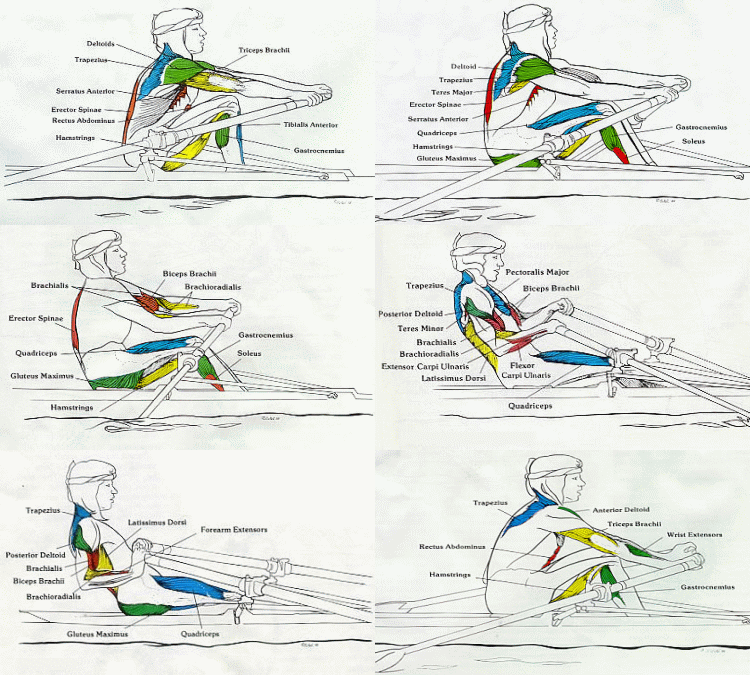
Force summation of a rower. (source: sportsmedbiotech, 2009)
Up goes the cry ‘Wing Chun does not use strength”.
Guess what? Conditioning and fitness are not just about strength!
I want to spend a few weeks looking at various types of and approaches to conditioning to make the most of our training, this may sound off-key but there is a great deal more to being effective at Wing Chun than just learning Wing Chun.
Fighting is a physical experience, so surely there needs to be a physical element to the training.
It makes no difference what so ever if we do ‘Internal’ or ‘External’ Wing Chun.If we depend on ‘Thought Force’ or ‘Physical Force’
If our body is not up to the task of performing as the blunt instrument needed to deliver our force of choice we could be in serious trouble the day we need to use it.
Hands break when they hit faces, this is the real reason Boxers wear gloves.
Talking to certain sections of the Wing Chun community about the need to introduce strength and fitness is as difficult and fruitless as talking to an Australian Liberal politician about the need to phase out coal.
Up goes the cry ‘Wing Chun does not use strength”.
Guess what? Conditioning and fitness are not just about strength!
It is just as much about building mobility to get out of the way, improving our VO2 Max so we do not gas out in 5 seconds or developing the resilience to not fall in a heap if we fail to get out of the way and get hit in the head.
Wing Chun very strangely does not have specialised training regimes such as Chi Kung of other T.C.M.A.
I have no idea why this is, it makes no sense.
But perhaps it does, perhaps we have just stopped identifying them as such, upgraded them to something else, helped of course by the post-war Hong Kong entertainment industry.
If we had not all fallen the romanticised exploitation of Chi Kung and Kung Fu that was perpetrated by the Shaw Brothers beginning in the early 1950s perhaps we would have realised that Chi Kung was a precursor of today’s sports science and maybe, just maybe Kung Fu would not have slipped into obscurity and disregard compared to Modern Combat Sports.
The idea of a genteel scholar defeating thugs was such a breadwinner for the Shaw Studios it was pretty much the theme of every movie, perhaps unintentionally it allowed weak unfit people to think they could compete if they just played Kung Fu.
Many still do.
Many are still wrong.
What conditioning do I think we need?
This is a very difficult question to answer, it all depends on what type of trouble we think we will get into.
I am sure we all think different things.
Do we need to be steady, stable and strong?
Do we need to be mobile, quick and adaptive?
Can we be both?
If we can begin to see all of the Forms as being conditioning exercises, at least at a base level, we are at least starting from a sound base.
By all means, keep seeing them as ways to circulate Chi if that is your approach but first let them be simply physical.
In my last post, I mentioned the ‘Stretch Reflex’ and how in some situations it can have a negative impact on our actions.
That does not mean that the ‘Stretch Reflex’ is always negative, there are many situations where it can be used to our advantage.
Understanding the ‘Stretch Reflex’ and how we condition our body and our thinking to work with it, and of great importance understanding that we cannot influence it in any way.
No matter what some people may say or even claim, we cannot train a reflex. Training is a conscious action, reflexes are unconscious actions.
To think otherwise is to pursue a fantasy.
But once we identify, understand and can predict the effect of a Stretch Reflex we can adapt our training so that it has less of a chance of working against us.
So that we have less of a chance of working against ourselves.
There are a lot of people that say Wing Chun does not work on account of some very sad YouTube fights, the simple truth is that a hobbyist, a weekend warrior, no matter how skilled or capable will always loose to a full-time combat athlete.
Survival of the fittest is not a cliche, neither in the ring or on the street.
If we wish to do better we must become more athletic, more dynamic, more physical, the whole IDEA behind the do not use strength argument is a misrepresentation, it should be “do not depend on strength”, which really is just another way of saying trust your skill first, however, if your attacker is smaller and weaker there is nothing wrong with using strength, it will work.
The popular sales pitch representation that doing Wing Chun will “level the playing field” against a stronger, bigger, faster, fitter opponent only works if the opponent has no skill, only brute strength.
Being faster, fitter, stronger does not guarantee a win, but it helps.
Get fitter, get stronger, get faster, get conditioned, and of course, keep improving your skill.
To move forwards in our training we must look backwards at what we did not achieve, and not just hope that going forward will somehow be better this year.
A new year, a new beginning perhaps even a new IDEA, a moon hidden by a fingertip.
In all sports and all fighting arts it is the basics that paint the clearest picture of what we are hoping to do.
These basics can be loosely thought of as maintaining a good shape and moving smoothly.
What are the Basics of Wing Chun?
The style is described by 6 Forms that are best viewed as two sets of three.
Set #1.S.L.T. Chum Kiu and Biu Gee.
Set #2. Wooden Dummy, Butterfly Knives and Long Pole.
The first three Forms introduce the movements of #1 the Arms, #2 the lower body and #3 the torso.
The second set of three introduces IDEAs on how to use the 3 Forms as a single unit.
Then, of course, there is Chi Sau, a dynamic method of exploring and understanding the different characteristics of the first 3 forms in an active feedback loop.
To be of the greatest value Chi Sau should be performed from the individual perspective of each Form set.
S.L.T. which is only the arms doing the work from a still body.
Chum Kiu where the arms are almost passive and all of the work comes from the lower body.
And Biu Gee where the arms and lower body are passive and the work is performed by the torso.
Before we commence any of the Forms or we engage in Chi Sau there should be a few moments of quietude where we turn off as much physical involvement as possible.
We just stand and observe what our body is doing when it is doing as little as possible, observe what our body feels like before it does anything active.
In a sports situation, this could be the pre-start position awaiting the call of Ready.
The obvious progression is … then set.. then go.
But we remain at the READY stage.
When our body is doing nothing it is not doing anything incorrectly.
The more familiar we are with this feeling or condition, the more comfortable we are with it, the easier our progress.
This feeling or condition will remain at the heart of everything we do, no matter how dynamically we move this stillness or at least the thought of this stillness must remain.
For the stillness to remain it must not get disturbed by our movement, early on this can be difficult to grasp, everything moves around this point and not from it.
In the First Form {S.L.T.} the arm movements must not disturb the torso.
In the Chum Kiu, the lower body must not disturb the torso.
In the Biu Gee, the torso must not disturb the arms or the lower body.
When the three body parts work independently without disturbance they use a natural unity that cannot be broken as they are not in any real way connected.
We all do this every day when we walk without thinking, like shopping.
Depending on how an individual relates to Wing Chun, especially from the hard/soft, external/internal perspective, this is where the thinking and the teaching takes a different choice at a fork in the road.
The external follow Shaolin Buddhist philosophies, the internal follow Wudang Mountain Daoist philosophies.
The finger-pointing at the moon, or the uncarved block.
I do not follow the path of Internal Wing Chun, the difference is massive yet unimportant, we all reach the same destination but the journey is very different, for some there is Chi, my way is physical.
In true Shaolin Buddhist, finger pointing at the moon way, what we work on is not what we are trying to learn, it is a path to the work, if we spend our time staring at the finger we will never see the moon.
The good news, however, is that the basics and the original condition are the same for both approaches.
Something we must never lose sight of is that if we do get into trouble, violent trouble, soft/hard, internal/external is just so unimportant, we will not use Wing Chun, we will just fight and hopefully, our training will inform and influence the decisions we make.
To move forwards in our training we must look backwards at what we did not achieve, and not just hope that going forward will somehow be better this year.







 Wing Chun Sydney, Australia