At its centre is Kung Fu essentially a system for converting energy.
Hey Guys,
Just a quick IDEA to consider that arose from a conversation I was having with Sam and Saleh last night.
The one thing above all else that ‘Combat Athletes’ mock Kung Fu players for is the way we talk about using ‘Energ’.
You all know that I am not a practitioner of Magical Thinking, I always try to firmly ground everything in known science, but there is no doubt that the Human Body is an ‘Energy Body’.
Calling this energy Chi or Nim Lik, {while this drives me crazy and I think that this IDEA is B.S.} Are we really just arguing over words, arguing over how we describe Kinetic {moving} and Potential {stored} energy in the human body?
The Science that informs my thinking tells me that ‘Energy can neither be created of destroyed, it just changes state”, this is the LAw of the Conservation of energy.
At its centre is Kung Fu essentially a system for converting energy.
A method of converting Potential energy into Kinetic Energy.
The ultimate goal of our training is to be able to perform this conversion under pressure and at will.
Think about this and see if you can feel the kinetic energy involved in doing the Form.
This is the GOOD JU-JU.
Trying to describe a feeling through a video is to be expected impossible, that is why we need to experience this together, but if you can think back a couple of years when we spemt a fair bit of time understanding ‘Core Winding’ especially in relation to individual muscles, that is where it lives.
Work on your weakness, but trust in your strength.
What message are we sending ourselves if we are trying to engage an opponent at medium to long-distance?
Hi Guys, and visitors.
This coming Thursday i want to go over the place of kicking in Wing Chun and the place of kicking in a self-defence situation.
This post is a few years old but it does the job I want it to do, and in accordance with Wing Chun’s Principal of “Economy of Movement” it is easier than writing a new post.
As you guys all know I believe that the most important attribute for a Martial Artist is honesty.
So honestly…
…does kicking have a genuine place in a Close – Quarter Combat style such as Wing Chun?
Let me clarify this when I say kicking I am talking about using our leg or foot as a primary attack weapon.
My teacher, Jim Fung {Chuen Keung} was an astonishing kicker and I witnessed some spectacular demos of his ability over the 17 years I trained under him, refer to the picture above to get some idea.
The thing is that kicks like the one above are, by my Sifu’s own admission, NOT Wing Chun.
He did them for the show, to attract more business because it was the type of thing new students wanted, and he always wanted new students.
Kung Fu Movie stuff.
But he was good at it.
Without starting a ‘Bun Fight’ over what is or is not Wing Chun kicking, because it really does not matter in the bigger picture, only results matter, surviving street violence is not an Olympic sport, no one is keeping score or awarding points.
However, if we claim to be doing Wing Chun then we should train Wing Chun.
Because ultimately it is not about Wing Chun kicking, it is about understanding the thinking behind Wing Chun kicking.
Those elusive ‘CONCEPTS’, that ‘Little IDEA”.
If, as we all repeatedly say, Wing Chun is a Concept Driven Fist Fighting style {KUEN} our theatre of operations is, at most, where we play Chi Sau, touching distance.
What message are we sending ourselves if we are training to engage an opponent at medium to long-distance?
I have always believed that Wing Chun is a ‘clever’ Martial Art, so let us take a clever approach to {sic} ‘Kicking’.
The video below was originally intended as the intro to a larger discussion on the merits of kicking, but I think that it is a good enough thought exercise to be viewed as stand-alone information, as a primer for the bigger picture of what is to come regarding how Wing Chun people use their legs in a violent situation.
As always, Y.M.M.V.
WHEN IT COMES TO ASS-KICKING, BE SURE IT AINT YOURS.
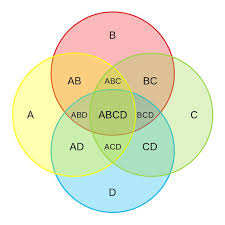
A = SIMPLICITY. B = PRACTICALITY, C = DIRECTNESS, D = ECONOMY OF MOVEMENT.
The Venn diagram above shows how describing simple IDEAS quickly becomes complicated when they interact with each other.
One of the earliest challenges we face when studying Wing Chun is in how we interpret the Fundamental Philosophy or, more accurately, philosophies of Wing Chun.
It is well accepted that Chinese thinking developed along a very different path than Western thinking, I am not implying that either is better than the other because they are so different that we cannot make any relevant comparison, fundamentally the values that informed ancient Chinese thinking are almost diametrically positioned to the values that informed ancient Western thinking.
From the outset, Chinese values have been concerned with the collective, whereas Western values have tended towards individualism.
I often discussed this with my Sifu, {Jim} Fung Chuen Kung, who spoke exceptional English, he would tell me that the best we can hope for is an approximation, and mostly not a very close approximation because when we try to justify or understand Chinese philosophy with Western Ideas we arrive at conclusions that make sense to our thinking, but does not coincide with the original IDEA.
Essentially, Western Wing Chun is a deviation from Chinese Wing Chun. It is still a very good Martial Art, but where we get sidetracked is that in the west, it is a Martial Art with a philosophical side, while originally, it was a philosophy with a Martial side.
When I talk philosophy in Wing Chun, I am talking about …
…a theory or attitude that acts as a guiding principle for behaviour…Oxford English Dictionary
and, of course, measuring everything by itself, by what it is and not by what we think it is or what we want it to be,
And in typical Wing Chun practice, we make it as simple as possible.
Philosophy is always an interpretation; this is the first problem.
The second problem is that, in relation to Wing Chun’s philosophy, it is also a translation.
In my experience, most Western students approach the work as a methodology, which, once developed, they attempt to retrofit with the philosophy, which ultimately leads to overthinking.
If we wish to get as close as possible to the original Wing Chun, it must be clear in our head before it migrates to our hands.
What we are after is acceptance, gained by practice and not belief based on obedience, and then use that understanding to shape our training; this leads to simple, practical, direct thinking.
But what does this mean in plain English?
We should aim to describe the philosophy in simple language, as if to a 7-year-old child, and then see how that compares to what we do.
One of the most obvious misalignments of methodology and philosophy is something that defines Wing Chun.
Counter Attacking.
So let’s begin with that.
Most people, and for a long time, I was part of that most, without realising it drop into methodological thinking when considering Counter Attack.
They immediately think about how to do it or what to do instead of philosophising and asking.
What does counter-attacking mean?
Then, use the answer as a guide.
Something I meant to mention in the video is that from a point of any Martial philosophy when we step towards our opponent, irrelevant of what we think we are doing, we are issuing force, we are attacking, our mindset will be aggressive, and the opposite is also true that any time we retreat from our opponent if we try to evade or avoid, we are defending, and we will adopt a defensive mindset.
In a violent encounter, how we think and how we feel will be by-products of the environment and situation. To a very large extent, they will be beyond our control; how we think affects how we feel, how we feel affects how we think, and they both affect how we act.
I had a prospective new student call me up the other day, he was in training with another school so when I asked him why he wished to jump ship he told me that on the few occasions that his life demanded more from him than grinding at Wing Chun he would get bombarded with texts and emails from the school asking him why he was not training.
He said they claimed they were simply trying to motivate him to keep up the good work.
I think we all know this story.
But it does beg the question.
As you all know, if you are away from training for a couple of weeks, I will get in touch to see if everything is going well, we are a family of sorts after all, but I never mention missing training, and I would never be so crass as to pretend it was motivation for your benefit.
As most of you have trained with me for years, you are well aware that I do not bug people to train; I do not even bug you guys to do the FORMS…
..hint, hint, do more FORMS.
My position on this IDEA of motivation is consistent with my position of Wing Chun being a Self-Defence System.
Emphasis on SELF.
If we do find ourselves in trouble, it will be our nervous system that will call the shots and not our social calendar.
Despite the deep and meaningless conversations around ‘Response vs Reflex’, self-defence is never expected; we will always be in crisis mode, and as such, everything will be ‘reflex’.
If any student needs external motivation to train, they are not training for self-defence, I do know that there are a thousand reasons to train, and in their own way they are all just as valid, but if you hope to reflexively use your training when you are not in your ‘Right Mind” it needs to be filed under Self-Defence, and not under Thursday evening if I am not too busy.
Bad Ju-Ju does not take a day off.
I am not saying that we need to train ‘hands-on’ every day; this would be counterproductive and lead to burnout, but we must remind ourselves why we train every day, just in case we get attacked on a Tuesday.
If we believe that violence is real, then we need to be real.
For those of you who train this evening, we will be working on readiness and understanding the ready position.
All good. Now that you have read the post, go do a FORM.
Here is an old video because what is a blog post without a video?
Knowledge is gained by adding something every day. Wisdom is gained by taking something away every day.
Becoming capable in any Martial art is not about being able to faultlessly perform certain movement sets; it is not about self-belief or being in the moment. As valuable as these traits are, they can be performed by a trained Monkey.
It is not even about knowledge, but without knowledge we have nothing.
It is about understanding; what we could call wisdom.
Without understanding, we are forever in the dark.
What do we need to understand?
Ourselves, nothing more and nothing less.
As simple as this may sound, it is one of the most challenging tasks any of us will undertake.
Especially as we begin this task from the position of not knowing, and of course; we are in the dark.
This is the role of Mind Boxing; it gives us an environment to begin ‘knowing’.
If we are involved in any training that requires a partner, we cannot work on ourselves.
Actions that are posed for us to understand how we operate, simply as a body in space, instead become about how to react/respond to this person or this situation.
Mind Boxing is a solo exercise.
First, we perform the task accurately and purposively, just like a trained Monkey.
The real work begins when we attempt to understand what we just did, how we did it, why we did it, how it can be used, how it can be adapted, how it relates to things we do outside of the Martial Arts, and most importantly how it relates to our styles fundamental philosophy.
Our philosophy is the light that drives away the darkness of not knowing.
Mind Boxing is how we integrate the philosophy into our way, DAO.
As a good starting place do you know, let alone understand, do you know what Wing Chun’s fundamental philosophy is?
If it was possible, I would teach this before any other aspect of Wing Chun, but I know from personal experience (meaning been there, done that) that this is just not what beginners think is proper, valuable training.
The problem of not understanding is that we are always in the orbit of “not knowing”, and because we do not understand that we are in the orbit of ‘not knowing’ we tend to think we know.
Most of us understand that for something to be “RIGHT”, it needs to be 100% “RIGHT” but what very few understand is that when we are 99% “RIGHT”, which is obviously not 100%, we are in fact 100% wrong.
Mind Boxing is not just FORMS, it is not even limited to Wing Chun specifics, below is an old video, this was something we did frequently when we rented a large training space, it is still something I do at least twice a week, it is obviously not Wing Chun, but once you begin to understand you realise it is as Wing Chun as Bong Sau.
There is a Daoist maxim that goes…
Knowledge is gained by adding something every day. Wisdom is gained by taking something away every day.
I get it, I do, I was there once, as were Sam, George, and Costas, and we felt and acted just as you guys are feeling and acting.
Hey Guy’s…
…The posts are coming thick and fast… just like me…
…In last night’s training, Thursday, Jan 30th, there was a noticeable change in enthusiasm between when we were working on the Form and when we started exploring technical ways of dealing with strikes and hitting people.
This is not a surprise, it is more fun playing at being a “Bad Ass” than it is training to become one, but deep down, we know violence is serious, so if shit got real, why would our nervous system choose to play when we need to get serious?
NEWS FLASH… it won’t!
What does that mean in regards to developing capability in Self-defence?
Are we wasting our time?
Like so many questions that arise through training, the answer is…. It depends.
It depends on how closely our playing echos our Forms.
And the inverse is also true, how closely our Forms echo our playing.
To navigate a violent situation, our body will, as if by magic, echo moves from Sil Lim Tao, Chum Kiu and Biu Gee, even when we do not know these Forms, this is part and parcel of the whole “Wing Chun is based on normal human body mechanics”.
Forms do not teach us these moves, shapes and postures; they simply allow us to isolate, practice, observe, and understand them in a non-threatening, non-dynamic situation.
And they help us to trust them.
The obvious next step is to take this knowledge into Chi Sau and free play, both of which are still non-threatening but present escalating levels of dynamism.
We do this at any and every time of our training journey, even when we get it.
This is very easy to understand and trust when like myself, Sam, George, and Costas you have been training for decades but is understandably ‘dead suss’ when what you want is the ability to defend yourself today and not the ability to accurately perform Sil Lim Tao.
I get it, I do, I was there once, as were Sam, George, and Costas, and we felt and acted just as you guys are feeling and acting.
This is why the non-physical side of the work is much more important and valuable than the technical side.
We did not believe that either.
There is not one move that any of you guys performed last night that you do not use somewhere in your everyday life, even punching.
The punching action, when done slowly with very little effort, is how you open doors, call elevators or do push-ups.
The first and perhaps the most challenging task is to accept that you can already do all the moves you need to effectively defend yourself, even before you began training, before you had even heard the name Wing Chun you had this knowledge and ability.
If we can accept this premise then everything becomes about improving what we already possess and not about learning something new and challenging.
Because you do not have the information to identify all of the Wing Chun Forms you cannot see that last night you were using aspects of Sil Lim Tao, Chum Kiu, Biu Gee, and even the Dummy, Knives and Pole.
The linear way that we present the Forms is just to make as smooth a learning curve as we possibly can, there are no laws in Wing Chun that state because you are at the beginning of training, you cannot work on Biu Gee, it would just be extremely challenging because Biu Gee contains all of Chum Kiu, and Chum Kiu contains all of Sil Lim Tao.
But it certainly does not hurt to look ahead.
The stats of this site tell me that almost nobody explores the other sections of the Blog, and when you consider that there is information here for students of all levels, all the way to Master level, everything you wish to know is here somewhere, why wait for me to point it out?
Here is a video from the Isolation Training Advice page, sometimes, finding something you want and realising you do not know how to do it is all the motivation you need to dig into the work
WHEN YOU UNDERSTAND, THINGS ARE JUST THE WAY THEY ARE.
WHEN YOU DO NOT UNDERSTAND, THINGS ARE JUST THE WAY THEY ARE.
Hi Guys, I truly believe that the wider our field of research, and as a result, the wider our net of influence, the more likely we are to find our own way.
But where do we look?
Sometimes, having a grasp of the general historical record is more useful than a specific history, especially one just associated with Wing Chun.
Here is some general info that I hope can give you some idea of what to look for but also what to be wary of.
Kung Fu began in the Shaolin Monastery, which was also the birthplace of Chan Buddhism.
According to legend, what became Kung Fu was specifically created to improve the physical conditioning of the Shaolin Monks to enable meditation, it should surprise no one that there is an interconnection between both.
During the Kamakura (1185-1333) and the Muromachi (1336-1573) shogunates., Japanese monks from the Five ‘Mountain Temples’ would travel to the Shaolin Monastery to study Chan Buddhism, which in Japan became known as Zen Buddhism.
The Temple guards that accompanied the monks to China would train with the Shaolin Temple guards and take Shaolin Kung Fu back to Japan, where it became known as Shorinji Kempo..
The variation of Shaolin Kung Fu known as White Crane also migrated to Japan, to Okinawa, where it was known as Karate-Do.
After the Chinese Communist Party’s victory in the Chinese Civil War, the nation’s leader, Mao Zedong, outlawed Kung Fu and destroyed most of the written history and recorded wisdom. To this day, there is a blanket ban on what Kung Fu was in its heyday, and as a result, today’s Shaolin Monastery is little more than a Martial Arts Theme Park, and any history has been heavily appropriated to fit the C.C.P.’s agenda.
In 1937, 12 years before the Chinese Communist Party came to power, Japan invaded China, and there has been no cultural influence or exchange since then, which ironically means that the blanket ban on all things Kung Fu by Mao Zedong did not have any influence on Japanese Martial Arts, which have become, to a certain extent, custodians of the original, fundamental precepts of Shaolin thought, simply because we can still gain access to Manuals and methodologies from groups and people that trained at the Shaolin monastery with the Abbots and Sifu’s that were active before the purge.
There are some very clear physical differences between the Japanese approach to Martial Arts and most styles of Kung Fu, but the non-physical things are still strongly aligned, and what is often referred to as a Zen Mindset would be very close to what a Chan Mindset would be if not for the Civil War.
Zen is Chan.
Kung Fu is Chan.
Taiwan was also insulated from the Mao Zedong blanket ban on Kung Fu, and as such, information from Taiwanese Kung Fu schools is as close to the original Shaolin Kung Fu that we can get.
It may sound quite insane, but Chinese history was rewritten from 1949 till today, and when we are talking about anything regarding Kung Fu, anything written after 1949 is pretty much B/S.
But there are a lot of good Kung Fu schools in Taiwan, and there is a shit-tonne of Westernised Zen writing.
Long story short, one of the most significant things I have become aware of is that we do all of our learning while we sleep.
This post is an intro to what I intend to be a relatively concise and probably long-winded look at the non-physical, intangible aspects of our training.
This stuff is a great deal more difficult to write about than it is to participate in, so do not get put off by this wordy approach.
As you all know my job in the 1980s required me to become familiar with the concepts and practices of “Lateral Thinking”, to the extent that I was sent off to a number of weekend even week-long workshops at the De Bono Institute for Creative Thinking, this in turn started my fascination for how the brain works and how the body interprets the signals.
Long story short, one of the most significant things I have become aware of is that we do all of our learning while we sleep.
Keeping this in mind, everything we learn, practice, train, or develop, be it tangible or intangible, physical or non-physical is a product of A SLEEPING MIND.
This places the whole physical or non-physical argument in a very strange place, but if nothing else shines a light n how important the INTANGIBLE aspects of the work are.
Q1. How often have you said or heard someone else say, “I was in two minds about it”?
Q2. How often have you said or heard someone else say, “ The guy was so Single-Minded”?
Q3. How many MINDS do we have?
It is widely accepted that we only have only one Mind, but I think we all have experienced situations, especially in training, where the mind instructs our body to do things we did not ask it to, in fact, it acts against our interest as if it was a separate mind.
For instance, when I do my party trick of asking you to straighten your Arms, usually standing with your arms folded as in the stance, instead of following the very simple, very clear instructions and straightening your arms, you raise them to shoulder level.
How did this happen?
Our mind double-guesses the situation and decides that what was asked for was to straighten them in front of us.
But that was not what was asked.
This may seem quite trivial, but what would happen if our mind did this in the middle of a violent situation?
OOPS!
This is the realm of what my old Judo Sensei referred to as “Mind Boxing”.
In case anyone finds it odd that a Judo Sensei would refer to ‘Mind Boxing” instead of “Mind Grappling” or whatever, we need to look at a small slice of British social history..
Between the end of W.W.2 and the explosion of Kung Fu cinema in the late 1970s in Britain all Martial Arts styles were regarded as some sort of Boxing.
Hence the Boxer Rebellion in 1900 Hong Kong.
To the rank and file in Britain this how Martial Arts were described, there was…
Roman Boxing or Pugilism which is today’s boxing.
Gentleman’s Boxing, which was the Victorian era Baritsu Fighting system.
Chinese Boxing, which of course was Kung Fu.
Japanese Boxing, which is Karate.
Styles that used their feet were and still are called “Kick Boxing” even though their names say nothing about feet.
In Europe, this was French Kickboxing or Savate.
Even today, the majority of Americans and Australians who have no active involvement in Martial Arts call everything Karate.
So when my Judo Sesei talked of “Mind Boxing” he was not talking about Boxing, in todays way of speaking he would have probably called it ‘Mind Fighting” or perhaps “Mind Martial Art”.
In the late 1960s trying to instruct young “Christian” students in what was essentially Zen Buddhism risked the wrath of angry Catholic mothers or at least an irate local priest.
So, just like my early Sensei, when I talk of “Mind Boxing “, it is simply a label that is used to differentiate between the physical and visible aspects of the work from the purely mental/emotional and intangible aspects of the work.








 Wing Chun Sydney, Australia