FIST LOGIC

ACCEPT WHAT COMES IN!

The closest we have to a working history of our style is the Kuen Kuit, a ‘Grab-Bag’ collection of training ideas and maxims created by numerous authors over different generations and situations.

Something that becomes obvious after time studying and teaching Wing Chun, is that none of the original ‘Fist Logic’ was passed down in any kind of stable or readily definable condition.

The IDEAS were passed down more like pieces of poetry than as an operating manual.

This is complicated by several magnitudes simply because we work with translations of the original ‘Fist Logic’.

Mandarin Chinese, and even more so Mandarin Chinese from before the mid-20th Century, does not translate well to English, this is the fault of English, the language is too compact and bereft of the necessary tools to accurately describe poetic nuance.

This is hampered even more because the same piece of Mandarin script can be read in different ways.

Even by native speakers.

Add to that that each speaker translates the script differently into English we end up with nothing concrete to work with.

The closest we have to a working history of our style is the Kuen Kuit, a ‘Grab-Bag’ collection of training ideas and maxims created by numerous authors over different generations and situations.

My Sifu {Jim} Fung Chuen Keung who was born and raised in Hong Kong and spoke excellent English said that even in Chinese they were not meant to be taken literally and that most of them did not make direct translations.

For instance take the maxim ‘Loy Lau Hoi Sung, Lut Sau Jik Chung’

One of if not the most pertinent of the Battle Songs.

My Sifu could translate this to be applicable to just about any situation.

Three that I can remember are

  1. Stay when he comes in, follow when he goes out, break contact and attack.
  2. Escort what comes in, follow what goes out, when the hands are free strike.
  3. When they advance, do not retreat, when they retreat advance. Discard the hands and rush straight in.

Subtle but genuine differences can make a very big difference in understanding.

Other Maxims worth thinking on are ‘The Wing Chun Punch comes from the Heart’, add to this ‘Wing Chun does not take a backwards step‘, my reading is that this was not meant as a positioning advice or a restriction on movement but rather what we English refer to as ‘Bottle’.

There are many more, Google Kuen Kuit and pick one that spikes your interest.

Exactly what does ‘He walks the bow but I walk the string’ mean to you?

These Battle Hymns, these Maxims can of course mean anything you want them to mean, choosing what you want them to mean is how you develop your own Wing Chun.

WHAT DAT?

“Out of every one hundred men, ten shouldn’t even be there, eighty are just targets, nine are the real fighters, and we are lucky to have them, for they make the battle. Ah, but the one, one is a warrior, and he will bring the others back.”
Heraclitus
.

HOKKA HEY.

FIST LOGIC

ABOUT TWO HANDED TRAINING.

THE SOUND OF ONE HAND CLAPPING..

 From day one, we are told that Wing Chun does not use two hands to defend because we use ‘Simultaneous Attack and Defence’.

As we all know and tell anyone that is willing to listen, Wing Chun is a concept-driven Martial Art.

 Therefore everything we are taught is a CONCEPT.

A suggestion not a rule.

Nothing is set in stone.

This can induce bewilderment, on one side of the coin nothing is wrong, on the other side of the coin nothing is right.

It is our job to think and decide.

The decisions we make will change from one situation to another and be dependent on context.

Tricky stuff this context stuff.

At the centre of Wing Chun’s “Fist Logic” we have a number of ideas/principles that are meaningless without context.

Simplicity. What is simple for one person is impossible for someone else so what do we teach?

Practicality. We do not know if something is practical until we use it, and only then if it works and we live to tell the tale.

Economy of Movement. Is ‘continuous punching’, a mainstay of our attack, Economy of Movement?

It is a minefield.

Another pillar of our Fist logic is ‘Simultaneous Attack and Defence’.

 From day one, we are told that Wing Chun does not use two hands to defend because we use ‘Simultaneous Attack and Defence’.

And it makes perfect sense.

 Until we forget.

Wich does not take very long.

By the way, it is never pointed out but we do not use two hands to attack for the same reason.

‘Simultaneous Attack and Defence’

F.F.S. NOW YOU TELL ME.

But then we have Chi Sau, the Chum Kiu Form, the Biu Gee Form, the Mok Jan Jong Form and the Baat Cham Dao Form all two-handed exercises.

Whiskey Tango Foxtrot.

There is a good reason for this two handedness, it is because even when we train we should try our best to be aware of and adhere to the Principles, to make them second nature instead of just a suggestion.

Paradoxically the principle in this instance is Economy of Movement.

We are not learning to use two-handed defences or two-handed attacks we are practising single-handed moves with each hand simultaneously, maximising our training time.

Our supervised training time, where we can learn new stuff or just get our homework marked, is a limited resource, so it is wise to maximise it.

Our solo training time is practically limitless.

Wherever possible do everything with just one hand, especially the Forms.

Think about it.

It changes everything, and it changes it for the better.

HOKKA HEY!

WHAT KIND OF DAY IS IT?
FIST LOGIC

SHAPES THAT WORK, AND MOVE.

DO YOU FEEL IT?

“this is the thinking, this is the shape, plug and play”.

This is a short clip from a private session I had with my student Rick.

Rick is new to Chum Kiu so it presented a perfect opportunity to change my methods from traditional approach of…

“this is the Chum Kiu Form, learn it, study it and in 10 years you may be able to use it”

…to how I think it should be taught from the perspective of Sports..

“this is the thinking, this is the shape, plug and play”.

If we can separate the primary aspects of a sequence and see them simply as “Shapes That Work” transitioning from one shape to another in any way that feels natural, instead of trying to make it look like a FORM, results in power and speed.

In Sports if we are trying to learn the motor function of an action it is broken down into shapes we should be in at certain points in the progression/sequence.

Think of FORMS as throwing a Discus or Swinging a Bat to hit a Ball.

If we practice progressing the shapes of

1. Neutral stance {Crazy Horse}

turn left into

2.Huen Ma {Cat Stance}

from here pose

3Hanging Horse Stance {Crane Stance}

step down into

4. extended Huen Ma {Reverse Lunge}

square up into

5. Huen Ma {Cat Stance}

turn back into

6. Neutral Stance {Crazy Horse}

Rinse and repeat in the opposite direction.

Make the transitions in any way that feels comfortable and in any direction that takes your fancy, this covers just about all moving possibilities we may need in any environment.

WORK ON THE SHAPES.

DO NOT STRESS ABOUT THE TRANSITIONS.

We will work on this for the next few weeks.

HOKKA HEY.
WHAT KIND OF DAY IS IT?
FIST LOGIC

IF WE TRUST IT WE WILL USE IT; IF WE USE IT WE WILL WIN.

WHAT STYLE IS THAT?

Watch the vid and lets get a healthy chat going, this really is the pointy end.

A common thread since the end of ‘Lockdown’ has been trying to understand how to actually make use of all of this sometimes exotic information.

Last night at training Saleh brought in some video capture of genuine street violence and it encouraged a decent conversation.

As hard as it is to understand and justify we will never use anything we learn in class out on the ‘Pavement Arena’ as Geoff Thompson calls it.

Watch the vid and lets get a healthy chat going, this really is the pointy end.

Many men appear calm for the simple reason that they have never faced a storm.

But when the storm comes they falter.

WHAT DAT?
WHAT KIND OF DAY IS IT?
FIST LOGIC

THINK IT, SEE IT, BUILD IT, BE IT.

I THINK, THEREFORE, IT BECOMES.

Expert level performance is as much about internal communication as it is about external movement.

I know that this hot on the heels of yesterday’s post but I wanted to address something before I became distracted and forgot about it.

FORMS AS A MEMORY FUNCTION

Something that is not in our face and as such often overlooked is that FORMS are also DRILLS.

We repeat the same set of movements over and again to “GROOVE” that action.

Performing a perfect movement may appear to be a physical thing but in reality all movement is a product of our thinking, an output from our C.P.U.

Our Brain.

Expert level performance is as much about internal communication as it is about external movement.

Think – send the memo – move.

Understanding the movement that we wish to perform is essential if we hold any hope of doing it correctly.

There are great gains to be had when we use our FORMS as a drill to aid and enhance our memory.

When I was quite serious about playing tennis I would spend hours working on just my service action, as a result my serve rarely let me down in matches when the pressure was on.

There is no difference between a body playing tennis and a body doing Kung Fu, or a body fighting.

This may sound a bit like compu-tech babble but better memory equates to higher competancy rates and better completion rates, vital stats in a violent encounter.

PHASE 2 [this is just a wee bit weird].

A deeply important aspect of FORMS training is that we are quite literally building a new person, and building a new universe for that person to operate in complete with new rules and new expectations.

This Universe is the Chum Kiu / Biu Gee Universe, if it helps in any way think of it like the ‘Marvel Universe’ and we are developing a new character to go help save the world.

This is not as ‘OUT THERE’ as it may sound, we have no REAL proof that we exist in this universe.

If we are training our Wing Chun for practical competency in fighting, which is of course the only goal to train for, the end game is to arrive at a predictable, repeatable, powerful, correct position and ‘physical end-state’.

It is all and only about the ‘END GAME’!

Do I hear you ask why?

Because where we begin any action will not be in our control as our action will be a response to an oponents action.

This is called ‘Counter Attacking’, wait a minute, that sounds a lot like Wing Chun.

And as such all of our training is about achieving the desired ‘end state‘ on the fly.

The SHAPE THAT WORKS.

In the place it works best.

As I frequently mention we need to be capable of thinking flexibly, of performing some at times tricky bits of mental gymnastics

It is an absolute ‘No Brainer’ that if we expect our training to work when we are in a perilous environment, then that environment needs to reflect, as much as possible, our training environment.

Most students shy away from even considering this.

But in reality, this is where the rubber meets the road.

MENTAL GYMNASTIC #1.

There is no way on Earth that the environment we find ourselves in will reflect the environment we trained in.

The task becomes being the same person doing the same thing in these diverse environments.

That Marvel Hero, doing marvelous things, in ‘our own’ marvelous universe.

MENTAL GYMNASTIC #2.

“The only way that we can live is if we grow.

The only way we can grow is if we change.

The only way we can change is if we learn.

The only way we can learn is if we are exposed.

And the only way that we are exposed is if we throw ourselves into the open.” — C. Joybell

HOKKA HEY.
WHAT KIND OF DAY IS IT FOR YOU?

FIST LOGIC

CONNECTING TO NATURAL HUMAN BODY MOVEMENT

A General Theory of Fighting Arts becomes grounded in Human Movement and not, as it so often is, ‘Esoteric Ideology’.

 The General Theory of Fighting Arts is a term widely used to try to get students to identify the mutual movements of all martial styles, and the alignment with most dynamic sports.

One thing we have all been told, and if we are talking to beginners or non Wing Chun people often repeat is that ‘Wing Chun movement is based on normal human body movement’.

I do not think that students give enough credence to this statement, that ‘Wing Chun movement is based on normal human body movement’.

It gets treated as if it is just some sort of cagey advertising spin just as many Instructors still claim that Wing Chun was invented by a woman, a device to encourage smaller, less athletic men to take up Wing Chun instead of a rival code.

But Wing Chun IS based on normal human body movements.

If we approach the work from this perspective and look at what is presented and how it is presented, we see a pattern emerge, that in the progression of the FORMS, as we move from the first Form to Chum Kiu and then Biu Gee, this progression is nothing more than the introduction of more complex movement for people not familiar with this way of moving.

This approach more than likely had merit back in 1860s Foshan but today, due to the average sporting curriculum of most western schools every 12-year-old child is familiar with these moves.

A very large proportion of what is introduced through the Forms is simply unnecessary, at least from the point of view of controlling our body.

Do not get me wrong, the FORMS are needed for other reasons so I am not suggesting abandonment.

But we can easily be moving at a level that is needed for any aspect of the work be it the Dummy, the Pole or the Knives if we put more practice and focus into moving better as a Human.

Take any movement or action from any sport, especially a throwing or bat and ball sport, and you will find the moves somewhere in the Form.

 A General Theory of Fighting Arts becomes grounded in Human Movement and not, as it so often is, ‘Esoteric Ideology’.

This week spend some quality time exploring the similarities between Martial Movement, Sports and Dancing, once you see how they amalgamate, consolidate and integrate FORMS become a secondary consideration. 

IMAGINE, MANIFEST AND WORK ON THE IDEA OF THE FRAME.

And while you a re at it put some minutes into the MAGNIFICENT SEVEN.

Here they are, and here is a recap.

WHEN YOU UNDERSTAND, THINGS ARE JUST THE WAY THEY ARE.

WHEN YOU DO NOT UNDERSTAND, THINGS ARE JUST THE WAY THEY ARE.

HOKKA HEY

WHAT KIND OF DAY IS IT FOR YOU?
FIST LOGIC

THE ONE INCH PUNCH AND MY SIFU, JIM FUNG.

PIC

THIS IS A PUSH, IT NEEDED TO BE. BUT THE POWER IS STILL THERE.

The amount of power needed to abruptly push someone off of their feet is commensurate with the amount of power needed to break things.

Richard asked the following question on our whatsapp Group page…

“Hi Derek, question for the week. The 1 inch punch. I have seen vids of Bruce Lee do it with a lot of torsion, and Sigung Fung doing it square on. Is there any practical use? Was Sigung Fung that powerful?”

It is important to understand the nature of any demonstration is basically ‘Infotainment’.

The amount of power needed to abruptly push someone off of their feet is commensurate with the amount of power needed to break things.

Like ribs and eye sockets, good luck finding a volunteer for that trick.

There are many internet trolls that watch a video of my Sifu and scream “Fake”,.

From a video.

How smart are they.

One of the reasons Wing Chun does not have sparring is because the average Wing Chun player wishes to avoid getting hurt and not engage in it, it is the same with any demo.

I have seen my Sifu perform this on many occasions, the body movement is minimal, the focus sublime, it is as real as a car crash.

But it is also a gimmick, or at the least a training exercise.

As I recount in the video my Sifu once gave me a serious tap, not really a punch, but it was as hard as anything I have experienced.

And I used to box.

EVERYONE. HAS A PLAN, UNTIL YOU PUNCH THEM IN THE FACE.

HOKKA HEY

WHAT KIND OF DAY IS IT?
FIST LOGIC

A TALE OF THREE STICKS.

PICK ONE.

Or of course there is always someone that asks ‘Will this work in the street’?

This is just a bit extra to keep our heads somewhere near what our training was.

It is meant to be light hearted and off beat but it may just come over a tad confused and delusional.

CABIN FEVER.

Over the years I have been teaching there have been many students that when shown something a little bit outside the box say ‘Can we do that in Wing Chun’?

Or of course there is always someone that asks ‘Will this work in the street’?

I get it, we understand that there is a bunch of ‘shitheads out there and we may just bump into them so we best be ready’.

But we do not know who they are so we do not know if what we are doing is enough.

IT IS.

It always was.

It always will be.

I also do a belated look at the Rubber Mallets.

STAY HEALTHY.

HOKKA HEY.

WHAT KIND OF DAY IS IT?
FIST LOGIC

SEEKING THE COMBAT BRIDGE.

ARNHEM – A BRIDGE TOO FAR.

It is your journey and your choice.

Richard asked if I could put a post up to cover as much of Chum Kiu as I could, I am pretty sure it will be of use to a few of you.

First off, when listening to anyone about any Form from any style stay aware of the fact that a Form is nothing more than a structural framework that allows the concepts to be laid out in a way that makes sense to the right person at the right time.

In due course we will all interpret the information [any Form] in a way that fits the way we think and compliments the way we move.

Remain mentally flexible.

Let’s get to it.

What is the best way to approach Chum Kiu?

We can approach Chum Kiu in as many ways as we can think up, it can be super simple such as “How many new moves are the in Chum Kiu that I need to understand”?

The answer to this is just 2?!

Pivoting and Shifting.

Or we can dig deep into every nuanced interpretation and now there are millions of ways.

The best is, as with everything, start small and grow, from the super simple to the insanely complex.

It is your journey and your choice.

CHUM KIU- A CLOSER BRIDGE.

There are some personal picks from the archive below that will help your journey and save you making a detour into the past posts department.

FROM THE ARCHIVE.

Here are some earlier posts that will help with the work and the training of the aspects we explore with Chum Kiu.

I recommend reading the text to the posts as it sometimes adds clarity to the context of the video, but if you are stuck for time, as we all are, just watch the vids.

This is a pretty complete overview of the Chum Kiu application from the perspective of vectors, but it is quite long, Video duration 18 minutes. https://wordpress.com/post/wingchunsydney.com/1456

This is a medium length video that helps understand the transition from Crazy horse to Chum kiu. Video duration 09 minutes. https://wordpress.com/post/wingchunsydney.com/2064

This pivoting primer that is one of the best videos I have done for information transmission that can be easily used. Video duration 11 minutes. https://wordpress.com/post/wingchunsydney.com/1482

This post will also aid with pivoting. Video duration 07 minutes. https://wingchunsydney.com/2020/01/18/tension-and-torsion/

This post is mostly about punching but it has good instruction on Core Winding. Video duration 05 minutes.https://wordpress.com/post/wingchunsydney.com/509

This post is about the often overlooked aspect of sinking and Rising. An inherent part of all movement. Video duration 07 minutes. https://wordpress.com/post/wingchunsydney.com/2331

This post covers the summation of forces. The heart of Chum Kiu. Video duration 03 minutes. https://wordpress.com/post/wingchunsydney.com/2290

HOKKA HEY.
WHAT KIND OF DAY IS IT?
FIST LOGIC, VIDEO

CONDITIONING, A CONTINUATION.

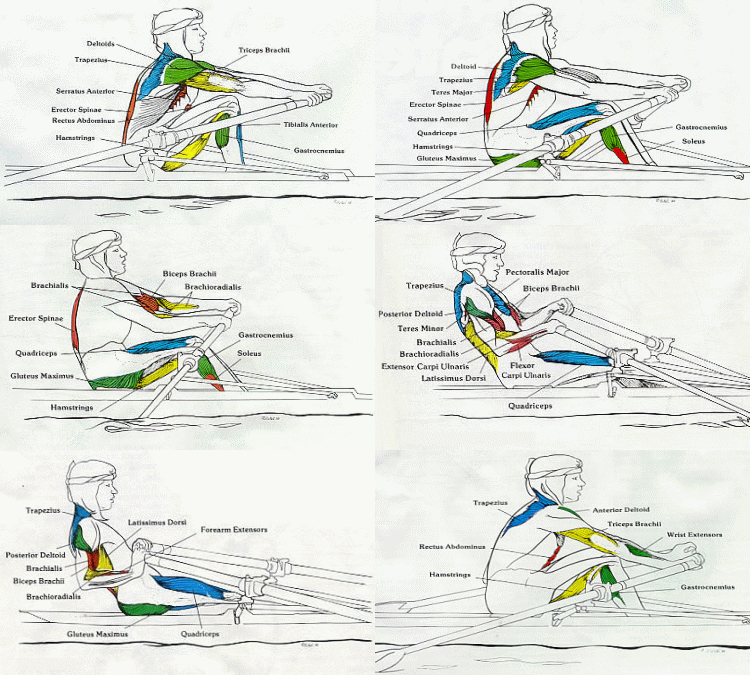
Force summation of a rower. (source: sportsmedbiotech, 2009)

Up goes the cry ‘Wing Chun does not use strength”.

Guess what? Conditioning and fitness are not just about strength!

This is a reposting from 18 months ago, but this is a vital piece of the puzzle. Rule #1 if you wish to win a blue, be a better human.

I want to spend a few weeks looking at various types of and approaches to conditioning to make the most of our training, this may sound off-key but there is a great deal more to being effective at Wing Chun than just learning Wing Chun.

Fighting is a physical experience, so surely there needs to be a physical element to the training.

It makes no difference what so ever if we do ‘Internal’ or ‘External’ Wing Chun.  If we depend on ‘Thought Force’ or ‘Physical Force’

If our body is not up to the task of performing as the blunt instrument needed to deliver our force of choice we could be in serious trouble the day we need to use it.

Hands break when they hit faces, this is the real reason Boxers wear gloves.

Talking to certain sections of the Wing Chun community about the need to introduce strength and fitness is as difficult and fruitless as talking to an Australian Liberal politician about the need to phase out coal.

Up goes the cry ‘Wing Chun does not use strength”.

Guess what? Conditioning and fitness are not just about strength!

It is just as much about building mobility to get out of the way, improving our VO2 Max so we do not gas out in 5 seconds or developing the resilience to not fall in a heap if we fail to get out of the way and get hit in the head.

Wing Chun very strangely does not have specialised training regimes such as Chi Kung of other T.C.M.A.

I have no idea why this is, it makes no sense.

But perhaps it does, perhaps we have just stopped identifying them as such, upgraded them to something else, helped of course by the post-war Hong Kong entertainment industry.

If we had not all fallen the romanticised exploitation of Chi Kung and Kung Fu that was perpetrated by the Shaw Brothers beginning in the early 1950s perhaps we would have realised that Chi Kung was a precursor of today’s sports science and maybe, just maybe Kung Fu would not have slipped into obscurity and disregard compared to Modern Combat Sports.

The idea of a genteel scholar defeating thugs was such a breadwinner for the Shaw Studios it was pretty much the theme of every movie, perhaps unintentionally it allowed weak unfit people to think they could compete if they just played Kung Fu.

Many still do.

Many are still wrong.

What conditioning do I think we need?

This is a very difficult question to answer, it all depends on what type of trouble we think we will get into.

I am sure we all think different things.

Do we need to be steady, stable and strong?

Do we need to be mobile, quick and adaptive?

Can we be both?

If we can begin to see all of the Forms as being conditioning exercises, at least at a base level, we are at least starting from a sound base.

By all means, keep seeing them as ways to circulate Chi if that is your approach but first let them be simply physical.

In my last post, I mentioned the ‘Stretch Reflex’ and how in some situations it can have a negative impact on our actions.

That does not mean that the ‘Stretch Reflex’ is always negative, there are many situations where it can be used to our advantage.

Understanding the ‘Stretch Reflex’ and how we condition our body and our thinking to work with it, and of great importance understanding that we cannot influence it in any way.

No matter what some people may say or even claim, we cannot train a reflex. Training is a conscious action, reflexes are unconscious actions.

To think otherwise is to pursue a fantasy.

But once we identify, understand and can predict the effect of a Stretch Reflex we can adapt our training so that it has less of a chance of working against us.

So that we have less of a chance of working against ourselves.

CONDITIONING – STRETCH REFLEX from WC INCa’s on Vimeo.

There are a lot of people that say Wing Chun does not work on account of some very sad YouTube fights, the simple truth is that a hobbyist, a weekend warrior, no matter how skilled or capable will always loose to a full-time combat athlete.

Survival of the fittest is not a cliche, neither in the ring or on the street.

If we wish to do better we must become more athletic, more dynamic, more physical, the whole IDEA behind the do not use strength argument is a misrepresentation, it should be “do not depend on strength”, which really is just another way of saying trust your skill first, however, if your attacker is smaller and weaker there is nothing wrong with using strength, it will work.

The popular sales pitch representation that doing Wing Chun will “level the playing field” against a stronger, bigger, faster, fitter opponent only works if the opponent has no skill, only brute strength.

Being faster, fitter, stronger does not guarantee a win, but it helps.

Get fitter, get stronger, get faster, get conditioned, and of course, keep improving your skill.

Learn how to walk and chew gum.

TRAIN YOUR WEAKNESS, WORK TO YOUR STRENGTH.

WHAT KIND OF DAY IS IT FOR YOU?