FIST LOGIC

WING CHUN, PHILOSOPHY, AND DAOIST ALCHEMY.

quote

Hey Guys,

After training on Saturday, I asked the question of us all…

 ‘Why was it that the most talented of Kung Fu Masters came from either the Buddhist Shaolin Temple or the Taoist retreat of  “Wudang Mountain”?

This connection has for hundreds of years been pounced upon by the Right Wing, New-Age Charlatans claiming that Martial Arts leads us to the light.

That meditation and spirituality, not effort and conditioning, deserve to be regarded as the true secret to effective Kung Fu, and why it is so suited to the higher man as opposed to the thug.

That it is not about violence.

This has always been the selling point, even back in the time of ip Man.

Initially, it was an attempt to clean up the image of Kung Fu in the wake of the Boxer Rebellion.

But soon, as it sadly is today, it became a con to deceive unfit, physically challenged, lazy people into thinking that progress comes from good thoughts and relaxation, not, as is the actual way, through commitment and toil.

One thing that greatly aided the Monks and the Hermits to become highly capable was an abundance of time in which to train, and the inescapable fact that in their society if you could not effectively defend yourself you were soon eaten up by those lower men who coveted everything you owned, and cared not how they got their hands on it.

The Bandits ran amok through the Pearl River Delta.

Need does what needs must, even for Holy Men.

If we could put ourselves in the shoes of the Shaolin Monks, or, especially with regards to Wing Chun, the  Wudang Mountain Ascetics, there was obviously something besides just time to train that helped them excel.

Every action in their lives was an action that only dealt with the immediacy of the moment they were in.

In Wudang Taoism in particular, the essence of everything they did was mental focus and deliberation on the ‘WAY’.

This was reflected equally in everything they did and was not somehow specific to their Kung Fu as some would infer.

This adherence to the “WAY” is usually described as Taoist Alchemy.

But what we in this modern time think of as Alchemy, which has been so vilified by the world’s religions that it is considered to be a type of ‘Black Magic’ was not anything like what the Taoist Ascetics thought of themselves.

They were simply seekers of knowledge,  seekers after the truth of what they saw around themselves, Life, the Universe, and Everything.

Which of course included their Kung Fu.

It was not so much that they were trying to learn Kung Fu fighting, but rather trying to understand this thing they did on the deepest possible level, as just another method to follow ‘the Way’ even in the most chaotic moments and situations.

In many ways the physical aspect of Kung Fu fighting was not part of the process at all, it was just a way to engage with the subject of the study.

And this is very much mirrored in Wing Chun.

Wing Chun is about how to think about fighting, which has the happy result of us becoming extremely proficient at it.

Because there was never the pursuit of the fighting skill there is not a finishing point as such, there is never a moment where we can say. 

I am a Master.

There is always more.

Or at least the potential for more.

Those now referred to as Alchemists would have thought of themselves as Philosophers involved in understanding the Natural World, which all men are part of.

Natural Philosopher was the term in use before the coining of the term Scientist.

Plato was an Alchemist, and Pythagoras was an Alchemist.

The Church of Rome claimed that Leonardo De Vinci was an Alchemist and condemned him to death for his thinking.

Alchemical thinking is not anti-religion but it is accused of this by every religion.

We all harbor personal biases, that were planted into us at a very young age, which may make it tricky to engage with this IDEA, the IDEA of understanding the thinking of Alchemists as a way to understand Wing Chun, but it was this thinking that created it.

The thinking of the Alchemists was just that, thinking, it was never intended or envisioned as a replacement belief system

Anything we do intending to improve ourselves is the core of what we call Hermetic Alchemy.

Once we know the moves of Wing Chun this is the only way forward.


“The All is Mind; the Universe is Mental.”

THE KYBALION.

THE WAY THAT CAN BE SPOKEN OF……

FIST LOGIC

S.L.T. IS CHINESE FOR NUANCE!!!

The difference between a Master and a Journeyman is measured by the depth of their knowledge much more than the quantity of their knowledge.

A few years after the passing of my teacher, and just as I had opened my own school, one of his senior Wing Chun brothers, Sifu Mo Chi Pu, visited us here in Australia.

I attended a workshop with a number of my students, wearing our new club shirt, which had on it in Chinese the script ‘Year of the Tiger 2010’.

 Another person at the workshop pointed at the shirts and quite disrespectfully said that I could not even get the Chinese words correct, Sifu Mo immediately admonished the man and said that it was indeed proper Chinese and that it was he, and all his generation, who could not speak proper Chinese, and that this script was the same Chinese script that would have been used by Ip Man himself.

This was of course just good luck on my part that the person I asked to give me the translation, who was older and better educated than the complainant, spoke proper Chinese.

On a subsequent visit, Sifu Mo stayed at my house and we talked about many things Wing Chun, including the changing role of language, and the passing on of information.

Understanding is governed by the quality of information.

Where we source that information and how we assimilate that information can be as important as the information itself.

Often the deeper content of the information is gained from reading in-between the lines so to speak.

From NUANCE.

The difference between a Master and a Journeyman is measured by the depth of their knowledge much more than the quantity of their knowledge.

But as language shifts, and gets bastardised, how do we curate genuine information for future generations.

The above tale points out another serious problem.

If we do not speak the source language we are always dependent on another person’s translation, even more perilous another person’s ability to understand and transmit NUANCE.

In a society where more people watch YouTube than read books we are in danger of losing the ability to “read in between the lines”.

Video is a sledgehammer, it rams information at us and into us so quickly and continually that there is no time to stop and think about the finer points as the next clip is already playing.

Yes, we could pause it, and engage of mind in contemplation, but how often do we do that?

Words, however, can stop us in our tracks.

The difference between the experience of the word Tarn Sau and a video clip of Tarn Sau are a few universes apart.

Lets us use Tarn Sau, Fook Sau, and Bong Sau as examples, but we could choose any of the movements.

When you say the word Tarn Sau what image does your mind produce?

The image in your ‘mind’s eye’ will be similar to a video.

Now think about what Tarn Sau means as a word, what it is as a movement, and how to perform it.

Different experiences I bet.

To understand Tarn Sau we must know what it means as a word, or more accurately as an IDEA.

But the Chinese language is logographic while Western languages are phonetic/syllabic, there is no equivalency and not even all Chinese people read the logograms the same way.

From my understanding {taking account of the fact that I do not read Mandarin} reading Chinese characters is all about interpretation, which of course leads to NUANCE.

My Sifu was a well-educated Hong Kong Chinese who spoke excellent English, his Wing Chun translations are the equal of any so I have always stuck with them.

He would describe Tarn Sau in two ways, as “Lay flat hand” and on other occasions, he would say “Palm up hand”.

While these explanations are clearly the same thing there is also great difference.

‘Lay flat hand’ implies movement, as in the laying flat action, while ‘Palm up hand’ implies orientation or shape, two different trains of thought heading to two different destinations.

‘Fook Sau’ was described to me as the controlling hand, where does this train of thought lead us?

‘Bong Sau’ translated to the ‘Wing Arm’, how do we explain this with a video?

Sil Lim Tao was translated to me as “The Little Idea”, yet we have six Forms with almost 1000 movements, Chi Sau, and numerous applications to show us this Little Idea.

Chinese characters are logograms that are constructed from ‘Little Ideas’.

In English, we could easily translate ‘The Way of the Little Idea’ as the way of the NUANCE.

We all know that Wing Chun is not about the movement or the shapes, it is about using these movements and shapes to reveal the ‘LITTLE IDEA’.

To find the ‘LITTLE IDEA’ we must develop the ability to read between the lines, this is what the Forms are for, to allow us a safe place to practice reading in-between the lines.

With Video presentations, any spaces between the lines get filled in with advertisements.

Yet the deepest truths are best read between the lines,

and for the most part,

refuse to be written.

Amos Bronson Alcott.

what moon?
FIST LOGIC

HIDDEN BUT NOT SACRED KNOWLEDGE.

Etymology… The occult (from the Latin word ‘occultus’; lit. ‘clandestine’, ‘hidden’, ‘secret’) is “knowledge of the hidden”. 

Hey guys, let me start by saying that there is no side to be taken with this post, no need to agree or disagree, it is just thinking out loud, and thinking should always be free to wander where it wishes to wander, and land wherever it wishes to land.

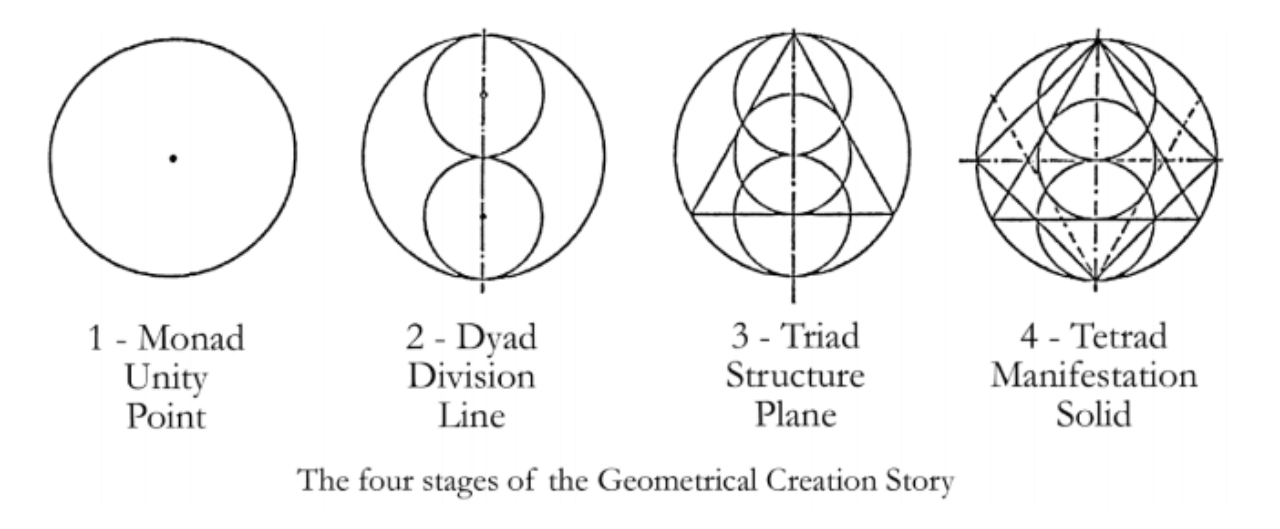
If you have done even the lightest study of Sacred Geometry you will see Wing Chun in the diagram at the head of the post, and as such there is nothing more for me to say.

If not read on.

This post has taken me more than 30 years to write.

And to be completely honest it has only crystallised in the last few years with my re-engagement with drawing and building sculpture.

If it does not make any sense at this time that is perfectly fine, just do not discount it out of hand because you do not understand it.

Something that I have told you all, in one way or another, is that we cannot hope to understand Wing Chun if we only use Wing Chun to try to understand it by.

In Neuroscience there is something called Gödel’s theorem.

This IDEA states quite clearly that no system is able to comprehend itself fully.

In short.. the brain cannot understand the brain.

As deep, nerdy, and perhaps even fluffy as this sounds it colours everything we see and think.

Which on the other side of the coin colours everything we think we see.

Wing Chun is a ‘CONCEPT’ driven martial art.

A concept is essentially an IDEA.

An Idea is a fundament of the ‘MIND’.

It is THINKING.

If we hope to understand Wing Chun as it was meant to be at its inception, surely we should start by trying to appreciate how Dr Leung Jan saw his place in the world.

To get some measure of understanding of the science and philosophy that permeated the society that Dr. Leung Jan was a part of.

Wing Chun was not a unique creation, it was a deviation from normal Kung Fu, a different type of thinking, a modernisation if we would like to think that way.

But its roots came from and cannot escape from the classical IDEA of Kung Fu, which itself was influenced by the philosophical cornerstones of Chinese upper society.

This strata of society possessed knowledge that was not common knowledge.

To the general population, it was looked upon as hidden knowledge, even secret knowledge. 

When these IDEAS are translated into Latin-based languages they are termed as OCCULT.

Etymology… The occult (from the Latin word ‘occultus’; lit. ‘clandestine’, ‘hidden’, ‘secret’) is “knowledge of the hidden”. 

In today’s common usage, occult refers to “knowledge of the paranormal”, which of course leads in the direction of ‘magical thinking’, as opposed to “knowledge of the measurable”, usually referred to as science.

It is so important to not conflate the modern IDEA of ‘knowledge of the hidden’ which always slips into magical or spiritual connotations, with the IDEA of ‘knowledge of the hidden’  from 17th century China, which for its time was actually science.

The Geometry and Mathematics of Chinese Architecture would have been considered occult thinking.

Gunpowder was a product of occult thinking.

It was not possible for their language to avoid being cloaked in what is now looked upon as spiritual terminologies, and spiritual theorems.

Whether we are pro-spiritual thinking or anti-spiritual thinking it is detrimental to our progress because BOTH lead us in an unintended direction.

Our challenge is to be able to connect today’s training to the thinking of 17th-century China, ignoring ‘New-age’ explanations and bring it into normality.

An example of how the ancients could translate religious IDEAS into secular methodologies that resonate with Wing Chun can be found in the Buddhist Heart Sutra that reflects…

Form is no other than emptiness.

Emptiness no other than Form.

Form is only emptiness.

Emptiness only Form.

If we can step away from even the lightest religiosity, this statement could be about the Sil Lim Tao, which in one old-world translation becomes the ‘Way of the Shaolin’.

Spiritual people living in violent times would, without thinking, use spiritual language about non-spiritual things, because that was simply how they spoke.

We should work diligently to not be moved in the wrong direction by words.

What was hidden knowledge to the ancient people of our world, and was still thought of as almost sacred in the time of Dr. Leung Jan is now taught to schoolchildren as a part of basic education.

Physics, Geometry, and Mathematics.

FIST LOGIC

THE WING CHUN CHEAT CODE, AND BARE KNUCKLE PUNCHING.

As frustrating as I found that answer back then, I now realise that it was pretty much a ‘CHEAT CODE’.

‘Forms’ training can seem unrelated to real-world violence, and as such it can take a while to get fully involved in studying them, and difficult to prioritise the time to do so.

But there is a way to learn all there is to learn from Forms in just 5 minutes a day.

It is almost as if there is a “CHEAT CODE”.

There is a pretty huge paradox at the heart of Wing Chun.

As large as this paradox is, it is not difficult to grasp, but it can be difficult to accept.

This is how it was explained to me by my teacher, {Jim} Fung Chuen Kung, 1944 – 2007. 

“In Wing Chun, there is only one IDEA {move or shape}.

This IDEA is an amalgamation of the 324 IDEAS {moves or shapes} introduced by the 3 Forms”.

This is the paradox, only once we understand all of the IDEAS {moves or shapes} as described by S.L.T. Chum Kiu, and Biu Gee, do we come to a realisation that there is and always was only one IDEA {move or shape}.

This more than likely sounds as vague and misty to you now as it did to me back then.

I have spent much of my 30+ years of studying Wing Chun engaged in trying to find easier to understand language or make a clearer explanation, but there is no other explanation that I can come up with that improves upon what my teacher taught me.

He once jokingly told me that we… ‘take all of our IDEAS and make them smaller, and that is how it becomes “the Little Idea”.

All joking aside, he was right.

On one occasion I asked him…  “If there is only one move, which move is it”?

He answered me… “Take your pick”.

As frustrating as I found that answer back then, I now realise that it was pretty much a ‘CHEAT CODE’.

One that we can use to cut years off the time it takes to become competent at Wing Chun, but for a full understanding, something that is not 100% needed for fighting but is absolutely essential if we wish to go on and teach.

To become a Master level practitioner we need to understand all of the IDEAS.

Another seed thought he gave me was that.. “When we study any of the Forms we should regard each IDEA {move or shape} as a stand-alone Form in its own right”.

Which, depending on how your brain works, leads us to see any Form not just as one IDEA, but as a collection of ‘Little Ideas’.

As I was writing this I was chatting with Frank, via the WhatsApp group, about the comparison between Wing Chun and Bare Knuckle Boxing, so I added about 10 minutes onto the end of the video to explore this.

As a result of this addition the video is now quite lengthy, 18 minutes, the first 7 minutes are about the Cheat Code and processing the Forms while from 7 minutes on I talk about Bare Knuckle punching.

HOKKA HEY.
FIST LOGIC

ASSERTIVE OR RESPONSIVE?

Long story short, there is only the work. 

ASSERTIVE OR RESPONSIVE?

What do I mean by this?

Before we get into this conversation we must establish a shared understanding of the context, the place, and the environment that the subject of this post covers.

If at any point in this post, you are not sure what I mean, pick the absolute simplest thing that you can think of that fits the bill.

Wing Chun is essentially the search for simplicity in all things.

When I refer to the violent interaction between two people I am referring to the embryonic moment of violence.

There is no attacker or defender in this situation, no right or wrong, no good guy or bad guy.

Just the moment itself, that half-second, one second or two seconds between someone striking out and that strike landing on its target.

It is happening and all nuance is out of the window.

In this pre-moment someone is assertive,  they choose to kick it off and step in to land the first blow, everything that is happening is their agenda.

While the other person has no choice but to be responsive, and to deal with this action, in this instant, there is no agenda except response.

It makes zero difference what that response is, it is simply a response.

Even if the responder pulls a gun and shoots the other guy dead, at the simplest of levels it is just a response to the other guy’s act.

Quickly imagine which of these people you are most likely to be similar to, but perhaps leave out the shooting.

If in our mind we are the instigator, and again ignore such flotsam as cause or reason, we are the asserter.

If we did not instigate the event, if our imagined response is aggressive, neutral, or defensive they are all the same, and any perceived differences are all just unneeded nuance.

This can be made simpler by asking “Are we the type of person that would cast the first stone”?

Be honest, keep it simple, avoid bullshit.

Wing Chun, by its own claims, is a “Counter-Attacking Martial Style.

One important point that is usually side-stepped because it becomes an uncomfortable conversation is that in times of stress when our conscious mind is overwhelmed and we rely upon our subconscious mind to save the day, our subconscious mind always reverts to type.

What type are you?

Assertive or responsive?

Two questions to ask ourselves.

  1. Is my training reflecting who I am?
  2. Reflecting on the type I fall into, am I doing the most suitable Martial Art for my subconscious mind to make decisions based on what my conscious mind has been training?

Many students expect their training to “Kick in” in times of need.

Even if our body was at all capable of automatically, subconsciously, making our training “Kick in”, this is a responsive action. 

The vast majority of YouTube videos, sometimes in conflict with what they themselves claim to be selling, teach or at least suggest that Wing Chun steps into the fray, taking the initiative.

It promotes ASSERTIVE behaviour as the way to use a RESPONSIVE Martial Style.

In what universe does this work effectively?

Let’s expand this discussion to take a closer look at this.

TRAINING KICKING IN.

Way back before YouTube came into existence, Charlatan Martial Arts Businessmen would claim that their brand was better than others on the market because it trained your nervous system.

The nervous system does not have synapses so it cannot think.

If it cannot think it cannot be trained.

The ‘Home World’ for all charlatans is the world of almost truths and unverifiable factoids.

And let’s not leave out ‘Magical Thinking’.

On a level footing with “Internal Chi Power” is the claim that someone or some style can turn your training into a reflex action.

You cannot train a reflex.

We train reactions.

Reflexes are automatic, like the instinct to pull your hand off a burning stove in response to pain. 

Reactions are those conscious responses to various experiences that we make that aren’t necessarily instinctive.

While we can train to improve our reaction to an established reflex action, we have zero input to the reflex itself.

Here is a grab from a medical study paper on the role of the C.N.S. with regard to reflex…

Central Nervous System.

  1. It consists of the spinal cord and brain.
  2. The brain is the main organ that controls the major functioning of the whole body of organisms.
  3. The spinal cord is a long tube-like structure enclosed by a vertebral column. It carries signals from the brain and transmits them to different body parts.

Reason for reflex actions to be controlled by the spinal cord and not the brain:

  1. Reflex actions are involuntary actions that involve reflex arc.
  2. The information through the reflex arc does not travel directly to the brain in most vertebrates.
  3. Instead, it travels through the synapse and reaches the spinal cord, which acts as the leading centre for these actions and sends an appropriate response for the stimulus.

Sadly some people will point to the above paragraphs and find a way to make it be the Brain calling the shots.

Our Brain does not communicate with our Spinal Chord by sending messages or IDEAS, it does not use words or pictures, so unless we know how to translate Wing Chun knowledge into a chemical precursor the Brain is not involved in directing reflexes in a Martial manner.

Charlatans, and pretty much all of YouTube, is set up to hoodwink the ignorant, naive, and lazy, those amongst us who want the results without the work.

Long story short, there is only the work. 

But wait there is good news…

The work is simple.

YOUTUBE…

WHERE WING CHUN TRUTH GOES TO DIE.

THE ‘D’ MAN.

REALLY… OH COME ON.

FIST LOGIC

THERE ARE ONLY TWO WAYS TO FIGHT.

It is not a simple binary choice such as this over that.

There are only two approaches to violent human interaction.

This is not about style, capability, conditioning or training, it is about how humans, in general, solve problems.

It is not a simple binary choice such as this over that.

Both approaches will allow us to reach our current potential, so in that respect they are equal.

All deliberate actions, such as using aspects of, or techniques from our training, are the product of our Conscious Mind.

 I think we all know this.

But what happens if we are not in an environment that allows us to make conscious decisions?

An environment where we are in a state of shock, even panic.

This is the very environment that most students expect their training to just ‘kick in’.

Let me repeat something…

“All deliberate actions such as using aspects of, or techniques from, our training, are the product of our Conscious Mind”.

What we are pinning our hopes on is that we can access our Conscious Mind in a situation where we do not have access to our Conscious Mind.

Praying that we can access our training when we cannot think.

Go over this as many times as it takes for you to make sense of what I am saying.

I will try to explain this in some depth in my next post, but first I want to clear our heads of misinformation.

Emptying the cup so that we can fill it.

Firstly we need to be able to take the 30,000 ft view by highlighting something that we are all immersed in without really paying attention to it.

YouTube.

This is a sore point with me so it may come over as a bit of a rant.

It is not meant to be but it is really difficult for me to talk about Wing Chun’s representation on YouTube without my true colours shining through.

Something I ask every potential student is “What type of fighter are you”?

You would be shocked by how many do not know how to answer this.

They tend to say something like “I am hoping to learn how to fight by learning Wing Chun”.

My answer is either the first real chance of personal growth they get, or it bursts their bubble and I never see them again.

‘Wing Chun does not teach people how to fight, it teaches people how to fight better”.

How do so many people get it so very, very mixed up?

To a certain extent, this has been amplified by COVID-19 but mostly I blame YouTube.

Since the Global lockdown more of us are using YouTube to seek out Wing Chun information.

But that is where it all goes pear-shaped.

YouTube is a shopping Channel.

And like all of us when we go shopping, people only buy what they believe suits them.

No one is actually looking for information, what they are looking for is validation.

They are looking for a YouTube influencer to tell them that while their thinking is a bit disorganised they are moving in the right direction.

If the YouTuber does not do this they look for one that does.

Why else would anyone listen to half of these guys?

Since COVID-19, YouTube has all but exploded with Wing Chun content, if that is the right word.

I do not blame the YouTubers, they are just trying to make a buck.

And I am not saying that they are wrong, if they get a sale, or a thumbs up, then it is mission accomplished, no foul there, only a fool would blame the salesman when they go out and pay good money by their own choice.

There is a very old maxim “Never buy a Pig in a Poke”, so this is no new occurrence.

But back to the question.

“What type of fighter are you”?

After all, there are only two types, and we all know which one we are.

We are either assertive or responsive.

But, just like someone who goes to town and buys the wrong shirt, we buy what we think can help us be the person we wish to be.

Instead of something that improves who we are.

Especially with Internet Shopping.

We have all got the equivalent of that pair of bright blue paisley happy pants that looked great at 4am after too much Scotch.

As I mentioned, there are only 2 types of fighters, this is an aspect of who we are and not what we hope our training will make us.

While it is possible to change which type of fighter we are over the medium term, we cannot change this to order, and we cannot be both.

YouTube is an Internet Shopping Channel that never has to face its customers, they know they will never need to answer to unhappy campers.

Unless they can get online after surgery that is.

Twp pairs of bright blue paisley happy pants for one cheap price.

Kevin Lee.

WHAT KIND OF DAY IS IT?
FIST LOGIC

THE SEARCH FOR THE LITTLE IDEA.

DO WE SEE WHAT WE BELIEVE? DO WE BELIEVE WHAT WE SEE?

This is a continuation of the last post, which itself was just the beginning to an approach to isolating the “Little Idea”, and glimpsing what makes Wing Chun “tic”.

Something that may only happen when Westerners get involved in Kung Fu is that the work quickly gets conflated with some level of spirituality.

I believe, as did my Cantonese/Chinese teacher, that this is more about the way our Chinese forebears used language.

A by-product of the way our Kung Fu predecessors approached “The Way” to live life in general.

Wing Chun was always populated by the “Middle Class’ of Chinese society, educated men who would have approached their daily life as a journey to becoming what the Yi Ching referred to as junzi 君子.

I have spoken before about the significance of Yip Man’s Peach Wood Knives.

And about how the monks of the Shaolin and Wudang Mountain Monasteries were spiritual men living in violent times, and not violent men on a spiritual journey.

Although it is not necessary to keep this in mind when actively training as it has no influence on the physical side of the work, it can act as a Rosetta Stone when thinking about the historical information that is passed down to us, as we approach the non-physical side, the conceptual side of the work.

The IDEA.

The little Idea is Simplicity, but what do we mean by this?

We are better served if we transpose the word to simplify or simplification.

To treat Wing Chun as a moving verb and not as a static adjective.

A description of ‘what it does‘ as opposed to ‘what it is‘ or what it looks like.

Simplify as in to make something less complicated, easier to understand, to remove unnecessary extensions, to reduce to basic elements.

Understanding of what?

Extensions of what?

Reduce what?

An absolute prerequisite here is to accept that Dr Leung Jan was simplifying an already well-established, well-trained, well-understood skill set.

His own fighting skill-set.

However, learning the actual skill set is not the goal of the training, it can be any skill-set.

Wing Chun is a departure point and not a destination.

To a certain extent, this whole line of thought depends on what version of Wing Chun Genesis we adhere to.

On what camp we are in.

Do we choose to align ourselves with the passed down tale, the IDEA that Wing Chun was created by Ng Mui and Yim Wing Chun or do we choose, as is accepted by so many researchers as a historical fact, that Wing Chun was a refinement begun by Dr Leung Jan?

If you are unaware of this research start HERE.

To prevent pointless partisan argument we can phrase this as ‘Do we think Wing Chun was a creation or a refinement’?

This brings us to the heart of the split among Wing Chun thinkers.

A crossroad that leads in very different directions.

Is it a religion or is it a science?

If it is a religion, what was done and what was said by the Elders is as good as law, and to attempt to change it is blasphemy.

It was perfect in the beginning, it is perfect now and it will always be perfect.

As disciples, our job is to accept the “Kernel of What Is” and build a fortress around it, never question it, never doubt it.

On the other hand, if it is a science, we are required to engage with it on a completely different level, an antagonistic level, we must always question, and we must always doubt.

Our job as students, using the scientific method, is to take this same “Kernel of What Is” and stretch it to the breaking point, to try to prove it wrong

And when we cannot prove it wrong, accept that it is only right for today, tomorrow we try to prove it wrong again.

Obviously, this is a binary choice.

While we can at any time retrace our path to the crossroads and follow the opposite direction, we must commit to our choice, whatever that may be, and not look back. 

We can of course choose to turn again at any time, many times even, but once on either chosen path, we must hold strong with our IDEA.

But whichever road we choose, we should keep in mind the opening passage of the Chinese Philosophical classic the Dao De Jing, which all of our Wing Chun predecessors would have been more than familiar with, even lived by.

The way that can be spoken of is not the constant way.

Laozi.

what moon?
FIST LOGIC

30 YEARS OF SIL LIM TAO.

Win a fight, get laid, lose a fight, get laid, it was a win-win situation.

This preamble to this post may appear out of place, even self-serving, but it is important if you wish to put your thoughts into the right context and understand what I am trying to say.

In a ‘Concept” driven Martial Art like Wing Chun, context is everything.

Context is usually the difference between understanding and confusion.

This post is a lead-in to a much larger body of work, that hopefully I will put into an E-book somewhere down the line.

I was 39 years of age in 1992 when I took up training in Wing Chun Kung Fu, and I came to the style with more than 35 years of experience in and around the Martial Arts scene.

This is quite relevant to my understanding and interpretation of the Sil Lim Tao.

Tune in to any newsroom in the Mainstream Media and they are full of dire economic predictions for the future, partly due to the fact that my generation, the ‘Baby Boomers’ are all entering or already at, retirement age.

Worldwide many millions of people are about to stop buying unneeded crap and stop paying taxes.

But if we step back 60 years we have that same many millions of children entering adolescence.

Unlike today, there was no internet, practically no Television, or at least none suitable for the growing youth of the growing countries, no video games, in short, no suitable and affordable way to fill the empty hours of growing up.

Even in a smallish city like Liverpool in England, there would be dozens, sometimes hundreds, of bored teenagers in the same place at the same time.

All trying to impress a potential sexual partner.

The cheapest and most easily accessed method was to show off.

And the cheapest way to show off was to fight.

No generation before or since has been involved in so much random, unprovoked, unjustified, street violence.

In Europe and America, Friday night was “Fight Night”.

School playgrounds became nothing short of a Gladiatorial training grounds.

This is what fuelled the Boxing Boom in the U.K.  And then the advent of the Kung Fu craze worldwide.

To my generation, Martial Arts existed as a way to become a more capable fighter.

But the real madness was that we were not training to become fighters.

We were training to be lovers.

Win more fights, get more chicks.

Insanely you did not even need to win, just standing up for yourself, especially against bullies, would earn some serious ‘STREET CRED.’

The chicks of the day just loved guys who could handle themselves or were at least willing to try.

So the majority of teenage boys got into it.

Win a fight, get laid, lose a fight, get laid, it was a win-win situation.

Mindfulness did not rear its ugly head until sometime in the mid-1980s when most Martial Arts were hijacked by the health and fitness boom and the charlatans that populate it.

So, like all of my generation, my approach is always about capability, fighting capability.

If you do not align with this thinking that’s fine, it just means you grew up in better times, but it does not make me wrong.

Sil Lim Tao.

From the outset, it is essential to separate Sil Lim Tao from the Sil Lim Tao Form.

Sil Lim Tao, the “Little Idea”, is the central pillar of everything we do in Wing Chun, but the Sil Lim Tao FORM is just one of six movement sets that aid in understanding the “Little Idea”.

A convenient, but in no way essential, way to frame this is that the Sil Lim Tao is a set of books in which the Sil Lim Tao Form is just the first volume. 

When we consider that I have been reading this set of books, over and over, for 30 years what do I think?

The “Little Idea”, as we all know, is a CONCEPT.

And CONCEPTS change every time they encounter new information, this is why CONTEXT is paramount.

I cannot ignore that what I think today is not even close to what I thought 20 years ago, but I do know, beyond any doubt, that the “Little Idea” has not changed.

 I have changed, or rather my thinking has changed.

Saliently, what I think now is not what I thought 10 years ago, and I would be naive to expect my present mental position to be my Final Position.

I do however think that I am very close to the Final Position.

The “Little Idea”, the single overriding concept is SIMPLICITY.

The actual shape and content of the training we do, while important, is almost irrelevant.

We could use any style of Martial Art, after all, when Dr Leung Jan began this process of refinement and simplification the physical shape and content were based on his own skill set, more than likely Shaolin Kung Fu.

Many of you will disagree with this, and that’s fine, it was not and is not about the content.

It is about SIMPLIFYING the content.

What a vague and nebulous word SIMPLICITY is.

Especially when we consider that once we have simplified what we know and do and have this new approach, this new IDEA of what Wing Chun is, it means that what we knew previously, what we struggled with, what we argued over, was not, in fact, Wing Chun after all.

But even before our head stops spinning we realise that unless we now know all there is to know, we must SIMPLIFY our IDEA of Wing Chun even further.

Stick or twist?

Even more confusing, if we do choose to keep training this new IDEA of Wing Chun is also not Wing Chun.

If it was why would we work at changing it?

Back in the day at my Sifu’s school, one of my regular training partners was an ex-Turkish Paratrooper who had achieved a 5th Dan in Tae Kwon Dao, he had even represented Australia, and he was seriously talented.

A groin injury forced him out of the hyper-athletic T.K.D. And into Wing Chun.

He would get super frustrated when after working hard for months on removing unneeded strength and tension from his training, and succeeding admirably I must say, he would be told to remove more.

How do we SIMPLIFY something that we have already simplified?

With this in mind let’s look at the Forms.

When we first encounter the S.L.T. Form it has 108 moving parts.

Pretty much as soon as the smoke clears we are down to 54 moving parts that are played on both the left and right side of our body.

Once we realise that what we are doing is often the same moving part travelling on a different path, the Form gets even smaller. 

Even less content.

Even less important?

Where I am today, there is only one moving part.

Do you know which one it is?

A SMALL MOVEMENT IS BETTER THAN A LARGE MOVEMENT.

BUT NO MOVEMENT IS THE BEST OF ALL.

unknown.
WHAT KIND OF DAY IS IT?
FIST LOGIC

NON-PHYSICAL LOADS THE PHYSICAL.

There are no second goes or makeovers in a street situation.

Where or how does the non-physical interconnect or interact with the physical?

On many occasions, you guys have heard me say that training is just software.

To better draw this picture think of complex programs like Photoshop or Illustrator, they can take months to get the basics down and then every few years there comes along an upgrade {we could think of them as gradings or belts}, that require a whole new truck-load of effort to get back to competency.

Here is the thing, if we put all of our effort and capacity into understanding and internalising the program, the only thing we will know is the program, and the only thing we will be capable of doing is teaching other people how to use the program.

Hence the saying…

Those that can, do…

Those who can’t do… teach.

In a martial art like Wing Chun that has almost zero force-on-force training knowing how to navigate this conundrum is vital.

Humans are social creatures and Wing Chun schools are social places, cliques and friendly groups form as if by magic, and we always seem to train with the same handful of people.

 So much so that the first half hour of training is not really training at all, it is a form of socialising.

As I say, we humans are social creatures, training becomes a somewhat social event, and as such training becomes a form of social behavior.

Same time, same place, same people, and the same training.

You know the thinking, if it is Thursday, it must be Kung Fu.

Add to this that what we call the work is learned and practiced in a social environment.

It becomes a social event.

Violence is the antithesis of a social event.

It is anti-social in the extreme.

So the challenge we face is not how to excel at the training, but more how to use what have become ‘social mores’ { ‘mores’ are social norms that are widely observed within a particular society or culture} in an anti-social environment.

If we find ourselves in a violent situation, whatever we choose to do MUST work on the first time of calling it up.

There are no second goes or makeovers in a street situation.

This in itself causes a dilemma, how do we bridge this shortfall in our training without descending into a ‘Fight Club’?

The place to start the change is to place more importance on the result than the action, essentially know what you want to happen when you use a specific aspect of training and then ‘make it happen’.

Another good habit is to stop telling ourselves we got it right if it was our third attempt, if we are in a “REAL” situation that needs that specific aspect of our training we MUST get it right on the first attempt.

Training is software, we are the hardware and the shit we are in is simply a problem to be solved by the hardware using the software.

But like any computer.

G.I.G.O.

THE EDGE, TO BE HONEST, THE ONLY PEOPLE WHO KNOW WHERE IT IS HAVE ALREADY GONE OVER.

HUNTER. S. THOMPSON.

WHAT KIND OF DAY IS IT?
FIST LOGIC

THE NON-PHYSICAL SIDE, MIND BOXING.

All of our knowledge, all of our training and pretty much our only hope is in the ZONE.

There is an obvious contradiction when we try to talk about what we could/should do in a dangerous, violent situation, and then use a safe, non-violent situation, i.e. training, to explore this.

As Sam said at the end of training “It is really just about composure”, and that is bang on the money.

But we must ask ourselves, ‘how can we practice regaining composure in a safe training environment where we are, if nothing else, composed’?

Even a style that uses full-contact sparring has this problem, we can always walk away if we are not having fun.

Believe me, being on the wrong end of a kicking is in no way fun.

Walking away is simply not on the table, running perhaps, but even then we need to engineer our escape.

And to do that we need as much composure as we can muster.

How do we develop composure?

How do we regain composure in a Shit-Fight?

Once regained how do we maintain composure?

No matter which style we train, it is just not possible to come close to the reality of this in training, there is no other choice but to imagine it, to set up scenarios where we can play-act what we think will go down.

This is not as bogus as it may first sound, reality only happens ‘in the moment’, and after that it is stored as memory.

Neuroscientists have shown us that the human brain sees memory and imagination as the same thing.

And all of the ancient wisdom traditions tell us that “We are what we think”.

Since the time of the Stoics in ancient Greece, the philosopher Epictetus told us that how we think changes how we feel, how we feel changes how we think, and that they both affect how we act/ behave.

In today’s psychology, this is the core of Cognitive Behavioural Therapy C.B.T.

As you know I am not a supporter of the notion of “Internal” Kung Fu, by which I refer to the act of generating a force from an unknown origin to power our attacks, to me, is just magical thinking.

But there is, beyond doubt, a non-physical side to training that should not be ignored.

Only a fool would say that fighting/violence is a purely physical experience.

There is a definite emotional aspect and a definite mental aspect, that we simply must find a way to accommodate.

For ease of explanation, I refer to this emotional/mental aspect as “Mind Boxing”

I do not use the term Mind Boxing because I can somehow box with my mind, that is just as bad as any other kind of magical thinking, I call it Mind Boxing because I believe we need to observe, understand, and train our minds as a separate, yet inclusive, part of our {Chinese} Boxing.

I believe this topic to be so important that I have a stand-alone website CLICK HERE.

To paraphrase and contextualise Epictetus…

How we feel in a violent situation will influence how we think in a violent situation.

How we think in a violent situation will influence how we feel in a violent situation.

They will both, in their own way, influence what we do in a violent situation.

It is important to not only accept this but to also understand that the quantity/quality of the effect of how we think and the quantity/quality of the effect of how we feel when under pressure is a sliding scale.

As such no one-size-fits-all solution.

The challenge becomes ‘Can we come up with a generic method that can provide value for all of us’?

We are not alone in this quest, every Elite Sportsman knows this search and luckily for us the Internet is awash with information from Sports Psychologists to aid in eliminating, what in less dangerous environments, might be referred to as ‘performance anxiety’.

To take a leaf from the book of Sports Psychology we need to create a template that we can slip into whenever we need to perform a specific task.

This is where a layman’s understanding of how our Mind works becomes essential to progress.

Everything happening to us ‘in the moment’, all stimuli, are processed by our short-term memory.

The short-term memory is our director, our captain, it calls the shots.

But the short-term memory has minimal storage capacity, by some estimates, short-term memory can only hold around seven items of information at one time. 

Anything deemed not mission critical is shunted off into storage, into our long-term memory, where the brain permanently stores the information for future recall when necessary.

How we deal with what is happening right here, right now, right in front of us is the remit of our short-term memory.

But if we get in strife and hope to call on our training we need to access long-term memory.

While we are actively training all of our training information is stored in our short-term memory, but as soon as we leave to go home that info is moved to long-term storage.

When we think about an elite sportsman playing flawlessly, and effortlessly, we say that they are in the ZONE.

Being in the ZONE is being in unobstructed, unfettered contact with our Long-term memory.

How do we access the ZONE when we are in the middle of an active shitstorm?

Because this is more important than anything else.

All of our knowledge, all of our training and pretty much our only hope is in the ZONE.

And as the ‘Brown Becomes Airborne’, we are not.

If we return to the Sports world we see suggestions of setting up cues or triggers, single movements or thoughts that call up complex actions, and complex movements without complex thinking.

If we think about our computers, we click an icon or an alias to open a program.

Addressing the Ball in Golf, preparing to take a penalty in football, waiting for a delivery in cricket, taking a set position in a foot race, and waiting to return serve in tennis are examples many of us will have experience of from school if nothing else.

In these ready positions, the emphasis is as much on setting the tone of our emotions and settling into a pre-trained mindset, only once we are happy that we have adopted these positions do we engage in our trained skill.

Self-Defence Martial Arts are anticipating being surprised, but I think we all know that we cannot expect the unexpected.

The only thing we can expect is some level of surprise/shock.

Do we have any IDEA how to move into and adopt a ready position whilst in a state of surprise/shock?

HOW WE FEEL CHANGES HOW WE THINK.

HOW WE THINK CHANGES HOW WE FEEL.

THEY BOTH CHANGE HOW WE ACT.

EPICTETUS. 130A.D.

WHAT KIND OF DAY IS IT?