FIST LOGIC

ROCKET SCIENCE AND THE BOXER REBELLION.

Wing Chun was Kung Fu for the new age.

Hey Tribe;

RICK recently sent me an article, written by someone about their experience while training in Wing Chun in Hong Kong.

To my sensibilities, it was a very odd article that used magical thinking as a way to explain how to do what we do.

It is not the first time I have read such opinions.

In fact, I first read about them as a 12-year-old boy while studying Chinese history in high school, way back in 1965.

This was the story of the Boxer Rebellion.

When the British established the first trade mission with China in 187? It was the beginning of a culture clash that China would never recover from culminating in the Boxer Rebellion.

The Boxer Rebellion was an officially supported peasant uprising of 1900 that attempted to drive all foreigners from China. 

“Boxers” was a name that foreigners gave to the Chinese secret society known as the “Righteous and Harmonious Fists” that was spread throughout Kung Fu Kwoons.

It was the “Righteous and Harmonious Fists” that prosecuted the peoples anger at the foreign interlopers.

The leaders of the “Righteous and Harmonious Fists” genuinely believed that Kung Fu, specifically Iron Shirt and Iron Body training, made them invulnerable. 

This was magical thinking of the highest order.

In August of 1900, this magical thinking was proven to be wrong as dozens if not hundreds of Kung Fu Masters fell to the European Muskets.

It was the old world v the new world. 

Mystic Superstition v Science.

In the wake of the Boxer Rebellion and the second Sino-Japanese war, both sides of Chinese politics embarked on a program to modernise itself and dispel all of the old superstitions.

It is worth noting that it was in this social climate that Wing Chun blossomed, with its principles of Simplicity and Practicality and its abandonment of the more esoteric aspects of traditional Kung Fu.

Wing Chun was Kung Fu for the new age.

But the more things change, the more they stay the same.

There has always been a split in the Kung Fu community along these lines,  some schools still look to the past with Chi Kung and the BaGua while others modernise by embracing sports science.

Even in Wing Chun.

My Sifu’s school was a massive school with something in the vicinity of 1000 students enrolled at any one time in 3 states and 30 sub-schools, to be expected there was a sliding scale of opinions.

A small cohort of the school would pilgrimage to Hong Kong and would return with a different IDEA of what Wing Chun is and how it should be trained.

There is no harm in this, training is not fighting, but many of the IDEAS began to spread like a virus through my Sifu’s school, and these IDEAS flew in the face of established science.

There was talk of being able to generate force without that force returning from the ground, dismissing Newton’s Third Law of action and reaction, and talk of the training accessing an area of the human brain unknown to Neuroscience.

Training that develops a force that is only known to the initiates of this specific type of training.

Echoes of Iron Body Training.

One side of this coin is that it is harmless fun to use magical thinking in our training, and to a large extent anything that helps and encourages someone to train more often and invest more effort is a good thing.

But the negative side of this harmless fun is that it ignores the things we know to be true, it leads us away from the honesty of everyday existence, and it encourages naive students to trust in things that do not work.

I understand the allure of this IDEA.

Who would not like to achieve Top End results without putting in any hard work.

It is the Kung Fu Law of Attraction.

Claims that we can create force without pushing the floor are disingenuous, to say the least.

Even when we stand completely still our body weight, powered by gravity, pushes the floor.

And the floor pushes back.

I think we can all understand that if force could be created without interacting with the floor, both N.A.S.A. and Elon Musk would be using it for rocket propulsion.

Yes, it really is Rocket Science.

what moon?
FIST LOGIC

ONE FORM TO RULE THEM ALL.

We are in the ‘End-Game’, only results matter here.

When Leung Jan began developing what we all now refer to as Wing Chun it was a method of refining his own, quite substantial Martial abilities.

Because of this, there were no specific conditioning IDEAs added to the new work, he would have already been using his previous conditioning from his previous style.

To fill this void we always needed to bring conditioning tools in from outside sources, and, where possible, convert them to align with Wing Chun’s thinking, our Fist Logic.

The most important skills to have if we wish to better our opponent in a violent interaction are speed, strength, and aggression.

Or more to the point the ability to deliver our Wing Chun training with speed, strength, and aggression.

This appears to fly in the face of much of the basic Wing Chun approach, especially once we explore how to ‘load’ what we do.

In my opinion, this is why Ip Man made the Baat Cham Dao one of his training protocols, to step outside of the box.

Wing Chun is a ‘FIST-ART’ after all, there is no need to add weapons.

Training is not fighting, they are closely related but not as joined at the hip as many think.

As clearly as I can state, training Wing Chun teaches us Wing Chun, but it does not teach us how to fight.

Each of us, in our own way, needs to be able to use the Wing Chun we have learned while engaged in what is essentially unrelated fighting.

In fighting, there is no time to think, no time to try it again, no place for relaxing, deliberately introduced softness, or any organised movement sets.

This is true of every style and not just Wing Chun.

The external attributes of speed, strength, and aggression, all of which are quite rightly excluded from training practice because they clash with our training ideology, are the backbone of the Baat Cham Dao.

There is no other reason for this FORM to exist, as I say, Wing Chun is a ‘Fist’ art.

This does not need to be a problem.

In the Big Picture everyday world that we think the brown will become airborne in, not everything we do needs to be Wing Chun.

Just because we train in Wing Chun, believe in Wing Chun and recommend Wing Chun, we have not in any way committed ourselves to some unbreakable contract that means that we can only use Wing Chun if we are in a dire situation.

Over the years I have helped hundreds of students with their training and at some time or another during practice, they have asked “Can we do this in Wing Chun”?

Do what?

Survive?

What is the Wing Chun end game?

Wing Chun exists to escape violence.

Holding an opinion that there is a raft of things we cannot do is sports thinking, imagining that there are rules that if broken can get us disqualified from the match.

There are no ‘Sportsman-like’ rules in an unasked-for violent situation, especially no rules that would force the referee to intervene and save our Ass.

To survive a violent situation we need to be faster, stronger, and nastier than our attacker, otherwise, at best, we are only a 50% chance of getting out in one piece.

Of all of our movement sets, the Baat Cham Dao affords us the opportunity to add the much-needed increased load to the training.

There are no new learning objectives in the Baat Cham Dao Form, we have done all of the actions and movements in a previous Form and should be comfortable with, if not capable of, making these actions and movements, so we have little need to focus on specific mechanics.

The overall scope of work we do in the Baat Cham Dao From is to gradually, but continuously, increase the load while trying to keep it inside the envelope of Wing Chun philosophy.

In training, we all try for perfection, but in a violent situation ‘close enough’ is usually good enough.

Especially ‘close enough’ delivered fast with unrelenting aggression.

Working in this way with the Baat Cham Dao allows us to find the limits of how fast we can move, how much strength we can use and how aggressive we can be before we erode the very stuff we have spent years trying to understand.

Forgetting our objectives.

During the journey, we commonly forget our goal.

Almost every profession is chosen and commenced as a means to an end but continued as an end in itself.

Forgetting our objectives is the most frequent of all acts of stupidity.

FRIEDRICH NIETZSCHE, 1844–1900

what moon?
FIST LOGIC

PLAYING WITH KNIVES.

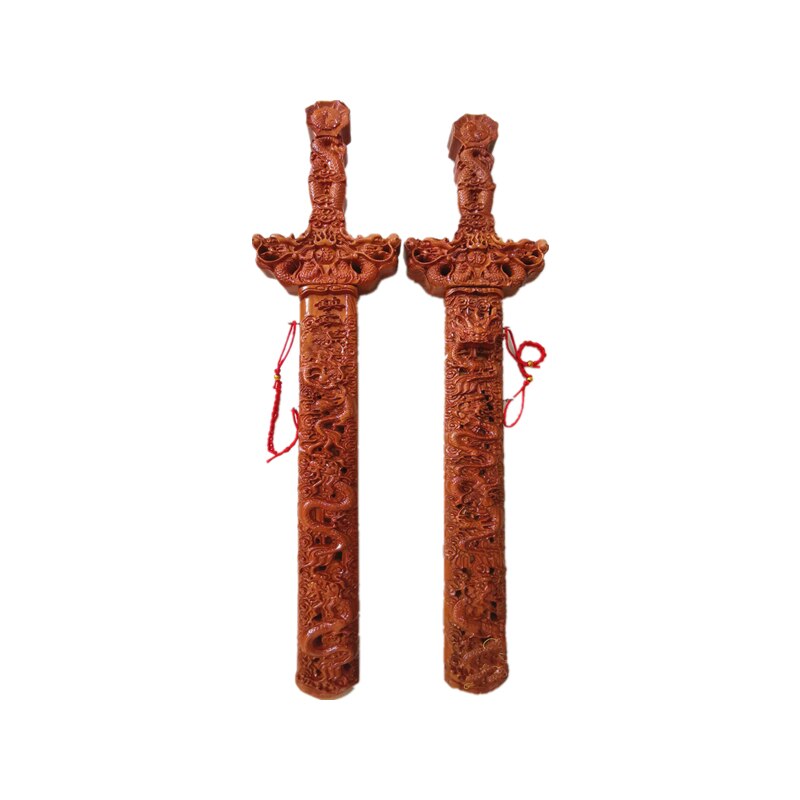
In Daoism, Peach Wood Swords are a symbol of a person that is trying to cut away the bonds that tie them to the world of men

If we can introduce an element of play to our training there is a greater chance that we will more frequently and more thoughtfully, engage in that training, and of course, more chance that we will learn and benefit from that training.

In Wing Chun Kuen, which as we know is a FIST ART, the Dummy, the Pole and the Knives are examples of such play.

They are theatre.

Their purpose is not to teach us how to use a weapon, but it is to teach us how to better understand, and by extension use, our empty hand skills.

To get the most from this playful training we should avoid thinking that it is the weapons we are learning.

And at all times try to see through the dance and observe the movements of the Body, and relate all moves back to the Sil Lim Tao.

WHY WE SHOULD ALL PLAY THE KNIFE FORM.

If we are talking about developing a working Martial Art that we can depend on to get the job done we should all be working with the Baat Cham Dao { Knives} Form.

Wing Chun was developed by Dr Leung Jan as a method to improve an already existing skill set.

To that end, the first three Forms are all about building a structure and studying the concepts, with very little that translates easily to applying Wing Chun to an attacker.

The Dummy, the Pole, and the Knives take the information delivered in the first three forms and make suggestions as to how we could combine them.

The dummy is mostly about understanding how to accept force, the Pole is mostly about how to issue Force, but the Knives show us how to move around while being active while potentially issuing and accepting force.

The Knife Form is the only Wing Chun Form that has anything remotely comparable to actual fighting moves.

Where it gets confusing is that the moves are for use in Empty Hand fighting.

Working on and with the Knives is still predominately defensive but that’s O.K. because Wing Chun IS predominantly defensive.

We cannot counter-attack until we are under attack, ergo, counter-attacking is defensive.

The length, weight, and balance of the Baat Cham Dao, which are truly dreadful from the perspective of a useable weapon, make it easy for us to be aware of multiple body connections while doing moves that are, like the moves of the Dummy Form, essentially Chi Sau.

The footwork in the Baat Cham Dao Form is out of Chum Kiu and Biu Gee and is presented in such a way that introduces sinking, rising, twisting, lunging, forwards movement, backward movement, sideways movement and oblique movement, that effortlessly links all of the work from the first three forms in a clear and concise fashion.

If we can resist the fantasy of thinking that we are using genuine weapons and allow the Knives to simply be a training tool, a feedback device, the Baat Cham Dao Form can lead to a dynamic understanding of Wing Chun.

Many of my seniors tried to tell me that the weapons were real, my Sifu even wrote a book on them, interestingly in his book my Sifu uses the moves with a squash racquet against an attacker.

But with regrd to them being genuine weapons one question they all struggled with was…

…If the Knives were added to the system as genuine weapons training it must be obvious that at that time and place, there was a very real need for weapons over empty hands.

If this is the case why are they introduced so late in the training?

Surely, they would be taught from the beginning if they were needed?

Think about that.

Taking a fist to a knife fight is no better than taking a knife to a gunfight.

Because the Baat Cham Dao is not a genuine fighting knife/sword we can replace it with any similar length and weighted implement and get all of the above elements and benefits from the work.

And the benefits are massive.

I know that when you look around YouTube you can see all manner of madness being performed with the Baat Cham Dao, but these are shifty people that are trying to sell something to naive shoppers, we really should know better.

On Youtube there are even people kicking while using the Baat Cham Dao, what is that about?

If we are kicking at an attacker we are outside of knife/sword range and as such if my opponent is unarmed I should close the gap and use the knife/sword, that is why we have it.

Alternatively, if the opponent is armed and out of knife/sword range as we try to kick they will chop our leg off.

The thing about common sense is that it is not very common.

The knife/sword moves in the Form are the moves we make in our ‘empty hand’ applications, the knives allow us to make a better mental connection to the correct alignment.

The treasure is found by practicing dynamic coordinated movements.

To keep this video inside everyone’s attention span I have not gone into the pure movement side of the Baart Cham Dao, I will do a separate video later in the week.

video

Back in the early days of the internet, I would seek out and gobble up any books I could find on Wing Chun.

I came across a book called ‘Conversations with Wing Chun Masters’ or something along those lines, it was compiled by an American so there were no inherent translation issues, unfortunately, I have long since lost it.

One such conversation was with a student of Ip Man that was also his nephew, a family member, who claimed that it was Ip Man himself that created the Baat Cham Dao Form and that he was almost coerced into it by his students.

In the early days of his teaching, sometime around 1950-51, Ip Man was reported to have had two Peach Wood Swords on the wall where he taught, which his students pestered him to teach them how to use.

Ip Man resisted because he claimed the Swords were fragile, somewhere along the line one of his students managed to copy the Swords and had a few pairs made from aluminium and presented them to Sifu Ip, upon which he created what we now know as the Baat Cham Dao Form.

There is nothing untoward in this, many Masters create their own Forms in their own Schools, and at that time nobody could have predicted how popular Wing Chun would become.

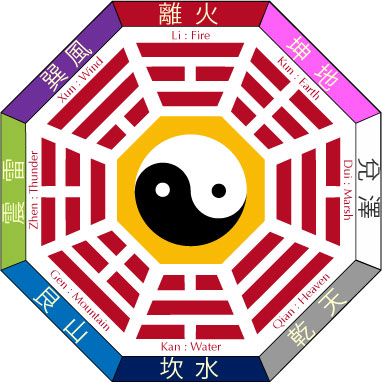
The nephew also said that Sifu Ip used the knives to explain the Ba Gua, something that during the mid-1950s came to be viewed as old-fashioned, mystic superstition and was dropped, but the Baat Cham Dao themselves remained in the system.

What always gave this story credence for me is that it was widely known that Ip Man considered himself a Daoist Gentleman.

In Daoism, Peach Wood Swords are a symbol of a person that is trying to cut away the bonds that tie them to the world of men and free themselves to walk a more spiritual path.

The Ba Gua is a Daoist tool that explores the connection to the 8 elements that make up the Chinese Spiritual Universe.

Baat Chm Dao translates to 8 cutting knives/swords, and the movement set comprises 8 directions.

WHEN IN TROUBLE…

THE ONLY WRONG MOVE…

IS NOT TO MOVE.

THE ‘D’ MAN.

FIST LOGIC

MORE ON SPRINGY FORCE.

It is the IDEA of how a spring works that we are after and not any specific mechanisms.

In training, we will focus on a certain aspect or concept, such as Springy Force, and describe it in a certain way, but the ultimate learning objective is to see how it works with everything we do all of the time.

Wing Chun is a multi-layered system, and like any system for it to work correctly and effectively every part of the system must interact with every other part of the system.

If just one part does not work then the whole system breaks down.

It is not practical or in fact useful to think along the lines of ‘this does that’ as all aspects can be used in numerous different ways, everything we do, every shape, every posture, and every action can be used for defence or attack, and as such requires us to be able to see things through a different lens in training and yet the learning objective is to combine both visions into a new and unique version of itself.

Although when working on and through Chum Kiu we explore Wing Chun’s defensive IDEAS this does not mean that Chum Kiu is exclusively defensive.

And when working on and through Biu Gee we explore Wing Chun attacking IDEAS it does not mean Biu Gee is exclusively concerned with attacking.

This is just a teaching protocol, a linear progression that is easier to navigate and understand than trying to explain the circular, multi-layered reality that is Wing Chun in an application.

As we all know if we are using Wing Chun to its optimal we are using simultaneous attack and defence and to be expected we are using both sets of IDEAS, both attack and defence, both Chum Kiu and Biu Gee.

Chum Kiu and Biu Gee are multi-faceted, the IDEAS and actions are many layers deep and while we may approach the IDEAS in a single-minded way the outcome we are after is a dynamic, constantly mobile combination of all the things introduced in both Forms.

Like a Lego set that moves in cycles of construction, de-construction and re-construction, the combinations are restricted only by our level of understanding and creativity.

To be expected this is also the case with Springy Force.

It is the IDEA of how a spring works that we are after and not any specific mechanisms.

The more we can understand about springs the more we understand about Springy force.

At times this can be a little confusing as we introduce explanations to fill out the IDEA, explanations that may in isolation look contradictory.

Finding comparable examples of the central IDEAS of Wing Chun in the real world can help us get a quicker understanding of what might appear to be vague concepts.

I think that most of us have an IDEA of the function of a car’s shock absorbers and how they can be adjusted to affect the height and quality of the ride, this is usually a function or quality based upon the stroke length.

As an analogy we can look at the tension in our body, be it intentional or residual, as creating a change to the stroke length and a change to the overall action of the Shock absorber.

A shorter stroke length is returns force harder and quicker, while a longer stroke length returns force softer and slower.

If you do not have this understanding ask Dr Google.

Power is described as the result of energy spent over time, the less time spent releasing a set amount of energy creates more power than the same amount of energy spent over a longer time period.

With the shock absorber the shorter stroke results in a harder result than the longer stroke.

The way we strike is a perfect example of a short stroke issuing more power.

As always the purpose of these videos is to help you all dig deep into the theory side of this thing we do, and of course, to hopefully inspire those of you that fell away during covid to come back to training, you know who you are and I know you still clock the videos.

While it is essential to understand the theories if we wish to be competent at Wing Chun, and watching these videos and reading the post will most certainly help, nothing beats the feedback that comes from supervised training and touching hands with your Wing Chun brothers.

 “Tomorrow’s victory is today’s practice.”

Chris Bradford

FIST LOGIC

SPRINGY FORCE.

Something to be aware of is that Springy Force is the reaction and not the action, we do not consciously try to create Springy Force.

Movement and Springy Force.

Everything we do, whether we are issuing force or accepting force, automatically, as a by-product of the Laws of Newtonian Physics, invokes return force.

Return Force in Kung Fu speak, is named Springy Force, but we can substitute return force if it makes things clearer.

It would make sense for us to develop a deeper understanding of why and how this happens in direct relationship to and influenced by Wing Chun. 

Springy Force is the Kung Fu layman’s term for Newton’s Third Law of Motion.

‘Every action creates a reaction of the same magnitude in the opposite direction’.

Just like a spring, hence Springy Force.

Something to be aware of is that Springy Force is the reaction and not the action, we do not consciously try to create Springy Force.

If we push something, or something pushes us, it is Springy Force that pushes back.

If we pull something or something pulls us it is Springy Force that pulls back.

It is however perfectly reasonable to train our actions with the desired outcome being the condition that brings about the activation of Springy Force.

In this way, we can anticipate the activation of Springy Force upon contact, even build it into our intention, but we are never truly in control of it or overtly involving it.

This is head-spin stuff.

The overall effectiveness of Springy Force will always be influenced by the quality of our connection with the antagonist, and to physical alignment.

The application of Springy Force in a genuine situation will be somewhat random, it is influenced much more by the action of the agitator than by our own actions.

The best vehicle to explore and set up the optimal condition for Springy Force to happen is controlled, organised, conscious movement.  

In other words, the best training protocol for this is Forms training, with the Pole being my go-to Form if time is restricted.

Every move we make should either be of compression or release [not expansion].

This is more a drill than traditional ‘Forms’ training with the goal of being aware of the different phases of movement.

Absolute stillness should be avoided and awareness should be focused on the transition phase of compression to release and release to compression.

In a genuine situation, compression will often be brought about by making contact or moving to anticipate making contact with an incoming force. 

In Forms analysis training, we deliberately set up the compression to give us context.

The only reason we create compression is to empower the release phase, the Springy Force, and not to affect our training partner.

Coordinating all movement from the perspective of the creation of ‘Springy Force’ compression and the release of the ‘Springy Force’ we have compressed, is an important aspect of all of our movement sets.

Especially for transitioning to a practical application or the issuing of force.

All of this type of training is about being aware of the thought behind the action and the relationship between each of them, with training this can become automatic where the thought alone triggers the action associated with that thought.

This is how Springy Force is activated.

We cannot feel our own Springy Force, we can only feel our training partner’s Force pressing on us.

Terms we use to describe this, such as “constant forwards pressure” lead us to think that it is an active pressure when it is a passive pressure.

To understand Springy Force it needs to be felt, to be experienced, no video can ever get close.

Interestingly, once we understand the condition to bring Springy Force into being, and its vital role in our defensive philosophy, returning their own force to them, doing the opposite is how we maximise impact, we prevent our Force from being returned to us.

I will make a video of this aspect the next time I am with the senior students.

IN A VIOLENT SITUATION,

THE ONLY WRONG MOVE,

IS NOT TO MOVE.

FIST LOGIC

GOOD CHOICE, OR WHAT?


How can we describe something when we do not even know if it will happen?

Hi Guys,

I am struggling a bit to find the best way to open this post, to find the right opening words and right feeling, so if it starts to come off a bit scattered or weird just stick it out, I am sure it will make sense by the finish.

Q…Is it possible to know if we have chosen the best Martial Art to get us out of a future, unknown situation, that we hope will not even happen.

A…As counter-intuitive as it may sound the answer is yes we can, and we can describe this situation with at least 90% accuracy.

This is what I mean about it may sound a bit weird.

How can we describe something that we do not even know if it will happen?

Every Martial Art is a specific solution to a specific problem.

So if we can describe the very things that Wing Chun is optimal to deal with, what it says on the box so to speak, we are describing the situation it is best suited to solve.

If this situation does not match the situation we fear we may end up in perhaps we have made a poor choice of Martial Art.

For us this is Wing Chun, but it applies to all Martial Arts.

In what situation is Wing Chun optimal?

If we are considering a situation that puts us in harm’s way, we only want what is optimal, any other choice brings a greater chance of failure.

WING CHUN KUEN.  

A COUNTER-ATTACKING, CONCEPT-DRIVEN, FIST-FIGHTING STYLE.

If we can unpack this description it shows us the type of situation we are preparing for, and just as importantly what we are not preparing for.

COUNTER-ATTACKING… By definition, we cannot be counter-attacking unless we are, first of all, under attack from an outside party.  We cannot be considered to be counter-attacking if we instigate the confrontation, Wing Chun is not intended for any kind of ‘Mano a Mano’ confrontation. We can dig into this a bit later.

CONCEPT DRIVEN… The ‘CORE’ learning objective is to understand the ‘CONCEPTS’ or ‘PHILOSOPHY’ of the style, the Forms, Chi Sau, and techniques are there to highlight or relate physical actions to the philosophy.  This is why it is so hard to say what is or what is not Wing Chun by simply observing a persons actions. We can dig into this a bit later.

FIST FIGHTING STYLE… Wing Chun is predominantly, but not exclusively, a hand-striking style.

Wing Chun does use kicks, knees, elbows, and even head-butts, but these are the exceptions and not the rule.  We can dig into this a bit later.

On first look, the situation Wing Chun will be optimal in is a surprise attack, something like a mugging, or an unexpected, violent turn in a difference of opinion that we did not really anticipate.

The level of surprise that we encounter will determine our chances of survival, if the surprise is absolute, if we do not see the attack coming, we have zero chance of success.

What can we do to lessen any chances of absolute surprise?

Sadly, nothing, that is why it is a surprise, however, we can increase our chances by not sleepwalking in dangerous places.

Awareness, but not hyper-vigilance, can prevent most surprises.

As short as this post is there is a lot to think about so I will leave it here to sink in, I will break everything down later on and hopefully you guys can bring things into training so we can flesh it out in a way that everyone can relate to.

If we train for what happens most,

we will be ready for most of what happens.

FIST LOGIC

INTRO TO ENGAGING AN ATTACKER

The Forms are nothing more than a loose collection of mnemonics, aids to memory.

For a very long time, I struggled to work on the Wing Chun FORMS.

I would get angry because so many of the moves in the FORM were just plain wrong, even by Wing Chun’s own metrics and I felt that I was being asked to accept something that I knew to be flawed.

How and when did things change?

Things changed once I realised that it just did not matter.

For some unknown reason, I thought that the FORMS were a complete and finished pattern that I needed to copy immaculately and that somehow I could not understand them if I did not do them perfectly.

This is not the case.

The Forms are nothing more than a loose collection of mnemonics, aids to memory.

Realising that it was not the content, the shapes or the moves that I was trying to learn changed the game.

The content of the FORMS was just a way to access the process.

Once I understood the process, the non-physical aspect, and the IDEA theory, I revisited the previous work and set out to correct the mistakes.

It was with untold delight that I discovered that the mistakes were really quite minor and concluded that they may have been included deliberately as a kind of hidden test and that the needed correction was already there, in the Theory of the IDEA.

I wrote about this some time ago in the post ‘Hidden in plain sight’, here is a LINK if we need to refresh your memory.

At that time I only saw Biu Gee in this way, but it is everywhere.

How could it not be?

FIST LOGIC, Uncategorized

COUNTER ATTACKING.

AN ATTACK ON MY DOG IS AN ATTACK ON ME!!!

it is so much more important to understand the philosophy of what we do as opposed to the methodology.

Hey Guys,

We have spent the early months of this year working on the not-so-obvious and not-so-visible side of Wing Chun, but at the end of the day, this stuff is only needed once we engage someone.

To get us back into the correct head-space to survive violence we need to change which thinking hat we are wearing.

We need our Counter-Attacking Hat.

What is the action we refer to as a Counter Attack?

Whenever we try to get deep into it we are confronted by the fact that we need additional information to put it into the correct context.

It is just not possible to talk about Counter Attacking without a concrete reference to what an Attack is, and this of course opens up the need to have a concrete reference to what Fighting is, the different phases of Fighting, the difference between Attacking and Defending, Fighting and Attacking, Fighting and Defending, in short, we need to have at least a personal opinion of the dynamics of violence.

 We train and approach Wing Chun as an answer to Violence.

This affects everything we do and everything we train, and it unavoidably creates a bias towards Function and Application.

I have been involved in enough violence to be acutely aware that no man can ever truly understand or in fact prepare for violence, it is just too expansive, and its appearance is usually random and unpredictable.

But as individuals, we owe it to ourselves to try to understand what we think violence is.

This will be different for every one of us, this is why it is so much more important to understand the philosophy of what we do as opposed to the methodology.

The reason we spend a decent amount of our training time attempting to relate what we are training to where and why we think we would use it, we often learn more about the practicality of our training from exploring our conversations than exploring the physical aspect of the training.

As a teacher I find these conversations so engaging because I find myself in a position where I am trying to answer many different questions with one simple answer, this leads to my own further development.

Before discussing the Philosophy of Counter Attack, let’s talk about the dynamics of rightly or wrongly expected violence.

VIOLENCE – A GENERLISATION.

Violence is multi-faceted and layered, it comes in many shapes and sizes, one on one, many against one, gang on gang, country against country every event is a new event that has so little in common with what came before the value of prior experience is far less than we may imagine.

In general terms violence comes in two flavours, let’s call them Social and Anti – Social.

SOCIAL VIOLENCE,

This is a FIGHT.

Fights are events between two people that have agreed to fight, a Match Fight, a Combat Sports competition or when outsides of sports someone says to the other something along the lines of ….

’I will meet you at such a place at such a time and we will sort this out’.

In this type of engagement, both parties know why they are there and what is about to go down, it is consensual, and they have given each other permission to use violence, there is no surprise here, there is usually some kind of support and a designated endpoint such as a knockout, one person being unable to continue or submission and then the thing is over.

If one of the fighters is injured help is never far away.  Schoolyard fights fall into this category unless it is a bullying situation.

ANTI-SOCIAL VIOLENCE,.

This is an unprovoked ATTACK, and in general what Non-Combat Sports Martial Artists train for, only one of the people involved knows the reason for this, only one person knows what the end point is, and it is usually incapacitation, there is very rarely support for the person being attacked and if at the end that person is left injured there is no guarantee of help.

This is a bad headspace that has a dramatic often debilitating effect on performance.

In the middle of this event, the intended victim may get the upper hand and turn the tables on the attacker, but only the roles change, the outcome remains the same, the victim simply becomes the attacker, and the attacker becomes the victim.

ANATOMY OF A VIOLENT EVENT.

Fighting, Attacking and Defending are three very different situations that cannot and should not be looked at as different aspects of the same thing.

Fighting is when two people are both engaged in the same event, trying to reach the same goal,  for the same reason, it is consensual, usually preplanned and allows for strategies to be thought out and implemented. This is primarily a competition mindset.

Think Boxing or M.M.A.

Attacking is when one person without any thought or concern for the other uses violence to further their own agenda. This is predatory behaviour, a predatory mindset.

Think of something along the lines of a mugging.

Defending is when a person that is under attack in any situation tries to prevent an attacker from hurting them.  This is a survivalist mindset.

It is important to acknowledge that defending does not mean fighting back, to fight back requires a change of mindset, this is the problem with thinking that Wing Chun’s Simultaneous Attack and Defence is a methodology instead of a concept, to be able to implement S.A & D we would need to be in two different mindsets at the same time, being in two minds is an expression used to illustrate indecisiveness or confusion.

MINDSET.

Mindsets govern how our body works, how it reacts to stimuli, what hormones the body creates and how much control we have over our movements.

There are major physical, emotional, mental and physiological differences between the mindsets that automatically develop when Fighting, Attacking or Defending, they are not even close to being the same thing, and they are incapable of being combined.

Do not just take my word for it, do some research, and check it out.

PHASES OF A VIOLENT EVENT.

From the Wing Chun training perspective what we think we would face in a violent event would have three distinct phases that require different thinking and application.  This does not include totally random surprise attacks, they are undefendable, most violence has some kind of precursor so we will at least be aware of the possibility of violence.

Phase #1.

The attacker is aggressive and animated, Wing Chun man is passive and ready, the attacker mistakes passivity for weakness and launches the attack without fear of retaliation, W.C man intercepts and presses forward with relentless attacks, possibly ending the threat there and then. 

If successful we move to Phase #3.  This is a typical training scenario.

Phase #2.

W.C.Mans first response did not end the threat, both men separate and regroup, the element of surprise is gone, and the attacker knows the game is afoot and will now be cautious, possibly use kicks, possibly try to rush in and overwhelm us, possibly set in for a long thoughtful brawl, Mano e Mano. 

This phase is completely unpredictable, and as such is rarely if ever approached in training.

Phase #3.

W.C. Man ends the threat and enacts a preplanned exit strategy. 

This is another aspect that does not get enough time in most training, it brings its own bundle of questions, the most pertinent being……..

What constitutes a win?

Do I stay or do I go?

To be continued…

COUNTER-ATTACKING DOES NOT REQUIRE DEFENCE, ONLY THAT WE ARE UNDER ATTACK.

WHAT KIND OF DAY IS IT FOR YOU?
FIST LOGIC

DOUBLE YOUR POWER? HIT THEM TWICE.

Creating power on contact is both simple and complex depending on which way we look at it.

Hi Guys.

Sadly there was a S.N.A.F.U. With the copy from Saturday morning’s training so the footage could not be used.

But I ‘really’ wanted to get some vision down while we are working on the IDEA that I posted to the WhatsApp Group.

A SLIDING MOTORBIKE IS ATTACK AND DEFENCE.

Imagine that you are crossing the road, and a motorbike comes barrelling down, for some reason the rider does not see you until the last second, he swerves to avoid you but the bike fishtails and the rear wheel takes you out.

This is ‘Wing Chun’ movement to a tee and covers many of the learning objectives of Biu Gee.

Things to observe and think about are that at the moment of contact, the rear of the bike is moving slower than it was before the swerve because of the rotation, but the front of the bike would be going at the same speed in the original direction.

And also it should be noted that this fishtail was not the intended result of the swerve, so there is no overt involvement with the contact.

It was not a plan, it was not deliberate, but the bike still knocked you out.

Hopefully next weekend I will go over the stuff we did on Saturday and try to get a record of the stuff we discovered, in the meantime I press-ganged Rick to help me out.

Creating power on contact is both simple and complex depending on which way we look at it.

Simple; Transfer as much of our body mass as possible into the contact point.

Complex; There are dozens of methods to do this, from the alignment of the frame to the hierarchy of movement, from increasing overall momentum to the summation of forces, and even increasing our weight through training, which is of course a method favoured by Combat Athletes.

Evermore complex; Accurately coordinate one or more of the above methods.

Our forms address all of this, however, we are required to cross-reference all Wing Chun information with known and accepted science, and we should at all times avoid magical thinking.

FIST LOGIC

JUST SHINING A LIGHT.

what does this say about our ability to use these methods in a situation that requires us to be “aware” of what is happening and what we hope to achieve?

To a large extent, this post is just me shooting the breeze, hopefully, to get us all thinking, and get us all talking.

There is a widely held opinion in the larger Martial Arts community that there is no such thing as genuine Wing Chun.

Some commentators regard this as a negative reflection of our style, while others, like myself, consider this to be a sign of continued evolution that has been at Wing Chun’s heart since Dr. Leung Jan first chose to modify his Shaolin-based Martial Art style. 

It does not matter what side of this argument we stand, as all of us that are a part of Wing Chun will tell anyone that chooses to listen that “Wing Chun is a concept-driven Martial Art”.

And that at its heart it is a single idea that is explained and interpreted through our Forms.

Dr. Leung Jan continued to adapt and refine his Wing Chun from his home at Gulao Village after he had retired and passed on his mantle to Chan Wah Shun, so from the outset there was a divergence in how the style was taught.

Chan Wah Shuns most celebrated student, Ip Man, taught an almost unrecognisable style from his master, and 2 of Ip Man’s most famous students, Chu Shong Tin, and Won Shun Leung, taught different approaches again, and both changed in different directions from each other in how they passed on Ip Man’s teaching.

My Sifu Jim Fung {Chuen Keung} trained under master Chu Shong Tin but also taught something quite different from his teacher.

But as much as things change they also stay the same.

The “Little Idea” at the heart of Wing Chun was originally and still is ‘SIMULTANEOUS ATTACK AND DEFENCE’.

The only difference between all past and present Masters is how we choose to explain and demonstrate this idea.

We should all spend a little time reading up on the evolution of Kung Fu in China, especially in the 18th and 19th centuries, of how it migrated from a Military Method to a Civilian Style, and to understand the changes that this brought about.

Military Methods focused on attacking and killing the opponent while Civilian Styles focused on defending oneself from unwanted attacks.

From its inception Wing Chun was a ‘Civilian Method’, ergo, it is a self-defence system.

This bifurcation between military and civilian practices provides a very neat Segway to talk about ‘Internal Kung Fu” and some of the new discoveries with regard to meditation.

The civilian cohort that practiced Kung Fu tended to be the same population that practiced Health and Longevity Exercises known as Chi-Gong.

As stand-alone doctrines, these required a large investment in time for each practice, so it should be no surprise that someone somewhere would see if the two different streams could be combined.

This was the motivation to create a new type of training that contained both combat elements and health/longevity elements, which became known as ‘Internal” training.

Jump forwards to 2023.

I was listening to a Huberman Lab Podcast with Stanford Neurology Professor Andrew Huberman and guest Sam Harris, who is also a neuroscientist, philosopher, and widely respected expert commentator on meditation and awareness.

It is a very long podcast but full of brilliant information and observations.

If you are at all interested in how our brain does what it does these are two of the very best guys to listen to.

The observation that really spiked my attention was when Sam Harris was talking about the different goals and objectives of meditation from a realistic and achievable standpoint.

Two neuroscientists chatting was a bit over my head but what I did understand is that the condition we relate to as “Relaxation” is a completely different condition to what we refer to as ‘Awareness”, and that they exist in very different Brain States.

He said that it is a misconception to think that the same practice can produce both ‘Relaxation and Awareness”.

We can achieve one, but not both.

Returning to ‘Internal Kung Fu” that is practiced with the goal of ‘relaxation’, what does this say about our ability to use these methods in a situation that requires us to be “aware” of what is happening and what we hope to achieve?

As you all know, I am skeptical about the benefits of any sort of ‘Internal” training on fighting ability, it is the reason I moved away from Hsing Yi Qaun and Bhaguazhag, both ‘Internal Kung Fu’ styles, so I may be reading into this something that is not there.

But Kung Fu to one side, here we have two experts in the field of neurology telling us that everything we thought was set in stone about the Brain/Body connection at the turn of the 21st century {Jan 01 2000 } is turning out to be incorrect, what does that say about information from the end of the 19th century {Dec. 30, 1899 }.

WHEN YOU UNDERSTAND, THINGS ARE JUST THE WAY THEY ARE.

WHEN YOU DO NOT UNDERSTAND, THINGS ARE JUST THE WAY THEY ARE.

ZEN SAYING.