Uncategorized

ARE FORMS THEORETICAL MODELS OF TECHNIQUE.

There is a wonderful book I often refer to when I am looking at deepening my understanding of the purely physical aspects of my own training,  “Biomechanics of Sport and Exercise” by Peter M. McGinnis, this is an extract from the summary at the end of one of the sections.

Summary

1. Develop a theoretical model of the most effective technique.

2. Observe the actual performance.

3. Evaluate the performance by comparing it to the most effective technique.

4. Instruct the performer by providing feedback about discrepancies between the actual performance and the most effective technique.

This approach is of course identical to teaching Wing Chun especially when using the Forms as references and practical examples of how to mechanically perform a movement.

Here is an extract from the summary of another section…

Summary

A basic principle of training is specificity, Biomechanics can improve the specificity of training by identifying specific aspects of technique that need to be perfected by identifying drills and exercises that mimic specific aspects of the technique.

Five steps are involved in a qualitative anatomical analysis:

1. Divide the activity into temporal phases.

2. Identify the joints involved and their motions.

3. Determine the type of muscular contraction (concentric, eccentric, or isometric) and the predominant active muscle group at each joint.

4. Identify instances when rapid joint angular accelerations (rapid speeding up or slowing down of joint motions) occur and where impacts occur.

5. Identify any extremes in joint ranges of motion.

Again we can see that Wing Chun training is pretty much in accord with this method, and this is why I personally have no problem ignoring the traditional line of thinking in Wing Chun and progressing everything from the perspective of Modern Sports Science.

It is clear to me that Wing Chun was always heading in this direction until it got negatively influenced by shonky marketing, dogma and pseudo mysticism.

A Sports Science approach would be first and foremost to understand the purpose or goal of the skill we are learning and the desired outcome once this skill has been learned?

For instance when we do Tarn Sau.

What are we learning?

What is the desired outcome?

I have made this point many times before if we do not know why we are doing something how can we ever know if we are doing it correctly?

Let us expand our thinking for a moment from why do we do Tarn Sau to why do we do any of the movements, even why do we do any of the Forms at all?

The desired outcome that we expect individually from doing the Forms could be really and quite remarkably different but the process should remain the same.

1. Develop a theoretical model of the most effective technique.

2. Observe the actual performance.

3. Evaluate the performance by comparing it to the most effective technique.

FORM OR FUNCTION?

From the perspective of Sports Science all training is task specific so there is only ever Function.

There is no value in practicing something that has no useable objective, apart from anything else one of the fundamentals at the heart of  Wing Chun’s Fist Logic is PRACTICALITY.

It should be noted that the purpose of some movements is difficult to define, but even in these cases the expected outcome should be clear.

If for instance we look at developing a relaxed manner of moving by doing the S.L.T. Form once we can move in a relaxed manner what do we do now?

What is the purpose and objective of this relaxed manner of movement?

For the sake of this conversation let us stick with Tarn Sau but it could be any shape, any movement or sequence.

What is the outcome we would expect from using Tarn Sau?

Above all else here it is imperative that we are honest and approach this from a personal perspective and not from some default idea that an instructor suggests.

We learn nothing by living someone else story.

For me I would use Tarn Sau to intercept and redirect force from an attacker on either the inside or outside of an incoming arm.

To achieve this I would need to be in a certain place, in a certain shape at a certain time with enough foreknowledge of what is happening to even have the chance to use Tarn Sau to achieve my objective.

Can we develop this ability by practicing Tarn Sau everyday in the S.L.T. Form?

Can we develop this ability by practicing Tarn Sau against static resistance in training?

It becomes very clear very quickly that there is a great deal more to achieving my objective with Tarn Sau that just understanding Tarn Sau.

Many Wing Chun Schools place great importance upon the Forms, especially the First Form and then on Chi Sau which is really only another Form anyway, very little is aimed at genuine Functionality.

All training must be task specific to be useful.


WHAT KIND OF DAY IS IT FOR YOU?
Uncategorized

BALANCE, STABILITY and COORDINATION.

Balance and Stability:

Keeping it simple Balance is maintaining equilibrium when motionless against nothing but the Force of Gravity.

Balance is motionless, if we are moving it is more accurate to talk about Stability.

Stability is maintaining or regaining Balance against outside forces, including forces created by ourselves, as in our own movement.

Balance is motionless and Stability is maintaining or regaining Balance, therefore Stability is about remaining or becoming still.

Some confusion arises because frequently Stability is referred to as either Static Balance or Dynamic Balance, especially if we include coordination, in this context :

Static Balance refers to the ability to maintain the body’s centre of mass within its base of support, as in standing still.

Dynamic Balance refers to the ability to move the centre of mass outside the body’s base of support, while maintaining postural control as in moving.

Balance and Coordination.

 Dynamic Balance is the ability to stay upright or maintain control of body movement, and Coordination is the ability to move two or more body parts under this control, smoothly and efficiently.

As always the best approach is to do your own research and form your own opinion.

Three important principals of Balance / Stability.

  1. A broader base of support {wider feet} increases stability.
  2. Keeping the line of gravity central inside the support base increases stability.
  3. A lower centre of gravity increases stability.

From a Wing Chun perspective, the lower stances / positions of the Chum Kiu and Baat Cham do are more Stable than the higher stance / position of the First Form {S.L.T}.

Getting back to the previous statement that “Balance is motionless and Stability is maintaining or regaining Balance”, it is more useful to think that Stability is about remaining or becoming still, we can see that the movements activated through the various Wing Chun Forms are not so much about moving to or from an opponent but rather moving from one position of equilibrium to another, moving to a new position of Stability, they are about stopping.

This is an important factor in power production and in keeping with the Conservation of Momentum Theory.

If we use the Chum Kiu Form as our testing ground the cycle of movements should go from being still {Static Balance} through the sequence or movement of choice, for instance the lateral shifting with Dai Sau and Bong sau {Dynamic Balance} culminating in stillness at the completion of the sequence or movement {back to Static Balance}.

The movement of the arms adds extra complexity to maintaining Balance by introducing new vectors but the main take away for the arms is in developing coordination of the upper and lower body, the action should fill the same time period, both stopping and starting,  as the movement of the legs and waist. 

If one moves they all move if one stops they all stop.

The Wing Chun Forms are subtle and use minimal movement deliberately, because of this it can be difficult to observe the movements in detail, it is often easier and more effective to have stand alone exercises to study this, once we are familiar with the connections between Balance, Stability, Coordination and Movement the understanding can be transposed onto the various Forms.

BALANCE / STABILITY OVERVIEW.

BALANCE

POSTURE.

CORE ACTIVATION.

Uncategorized

TAKING A POSITION OF DOMINANCE.

What we train is not what we will do if we find ourselves in a violent situation, this is not the problem it may at first appear, it is the same with every Martial Arts Style, what we will do is try to get out of that situation and hopefully our training will influence the decisions we make.

The position we train in, the orientation to our partner / opponent is unlikely to be where we will find ourselves, the Bad Guy will make that choice, and you can put money on it that if they can they will make sure that it will be as good a spot for them as possible and a bad place for us.

Our first response must include repositioning, preferably as we intercept the attack, this is something we need to accept, understand and be comfortable with.

We will all have our own preferred place to be where we feel comfortable that we can do our best work, a very large part of our training should focus on securing that place, that position.

A POSITION OF DOMINANCE.

An overview.


Adopting a better position.

Uncategorized

VIDEOS FOR EXPLORING CHUM KIU.

None of our forms can teach us anything except how to move in a particular pattern, all Forms are solo training, it is only once we get a partner to provide resistance or force that we can begin to explore how to use this pattern to reflect the Fist Logic that is Wing Chun.

Because none of our Forms can ever teach us anything practical they can never be seen as right or wrong.

Here are some IDEAS to begin your own exploration of Chum Kiu.

These Vid’s are quite old, the information is sound although the presentation leaves plenty to improve, I will update them in the not too distant future.

Using the Body to support the Arms.

An Intro to Pivoting.

More on Pivoting.

An Intro to Shifting.

More on Shifting.

Easy Partner Training.

Active Chum Kiu.

Uncategorized

THOUGHTS ON BIU GEE VIDEOS.

Biu Gee is by far the most complex of the first three Forms, the Jewel in the Crown, as these are stand alone videos from my old Blog there is some repetition of information.

Transitioning from Chum Kiu.

Meeting the Biu Gee

Biu Gee Rotation.

Overview of the Power Shift.

Overview of Power Production

Biu Gee Shoulders

Opening the Upper Torso.

Understanding our Biu Gee Shoulders.

Adding forces in Biu Gee.


Uncategorized

CHI SAU.

IT IS JUST A GAME OF HANDS.

ROLLING BRIDGES.

Chi Sau is Chum Kiu, we seek our partners bridge and then try to roll it away, the seeking of the bridge in Chi Sau is an “Internal aspect”, we seek to place our awareness in our partners bridge, we are not “Externally” pressing our partners bridge, we are not trying to find it.

Think about this for a moment.

If Chi Sau is to prepare us for combat, and if Wing Chun is a “Counter-attacking” martial art we have no need to try to find our opponents arm / strike because it is in the process of finding us, we just wait and meet it.

 It can be very difficult to maintain this Internal idea while playing Chi Sau, our Ego wants to get involved and tries to control or manipulate our opponent, we can even engage in a type of sparring through Chi Sau, which if you think about it, and you are honest, is a total contradiction of all Wing Chun theory.

What is the learning objective of Chi Sau?

If Chi Sau is Chum Kiu and Chum Kiu is how we address the moment of contact then Chi Sau is equally about how we address the moment of contact. 

In application we would be talking split seconds of active contact and not minutes of rolling.

Make contact – roll away, break contact – punch.

Wing Chun uses chain punching when attacking, or at least relentless striking, so we would make contact and break contact in the blink of an eye.

In training when practising basic Lok Sau, the rolling arms, only one person, partner “A” can be actively involved in a Wing Chun learning objective, the other partner “B” deliberately and purposefully suspends all Wing Chun theories and engages in pushing and applying direct force to “A’s” bridges. In this way “A” can work on how to maintain his shape, his “Body Being”, rolling away “B’s” force and taking the weight into his own body.

“B” is not trying to hit “A” just apply steady pressing {however it is beneficial if the shapes are like strikes}, in this way “A” can experiment using Chum Kiu pivoting and shifting under pressure, observing what happens when you pivot with a Chum Sau, shift sideways with a Tarn Sau or shift back with Jut Sau.

Without presence of mind, constant awareness of the objective, and good supervision this can degenerate rapidly into  Arm Wrestling.

Chi Sau is not concerned about moving our opponents arms, this happens as a by-product caused by our own movement, Chi Sau is about developing trust in the fact that we cannot be prevented from moving our own arms any time and anywhere we think fit irrespective of the amount of force presented to them.

This is how we gain confidence in our defensive structures and ideas, this is how we learn.

Another learning objective in Chi Sau is the development of sensitivity.

Sensitivity to what?

I have heard it said that we are gaining the sensitivity to feel what our opponent is intending to do so that we can pre-empt them, even if this was possible it would only be of use when playing Chi Sau when we are rolling for minutes, it would be redundant in the split second of make contact – roll away, break contact – punch which is the reality of what Wing Chun does in combat. 

I do wish to be sensitive to my partner, but only in so much that I can be aware of where his weight is coming from so that I can understand what shape I need to be for it to enter my frame and settle in my centre so that I can destroy his stability with my movement, once I have this knowledge tied down and stored away it will become the shape I choose to make contact, mostly I want to be sensitive to myself, to what is happening to my “Body Being” while engaged.

Information is drip fed to us through our Forms, jigsaw pieces dropping at different times for no real reason, my Sifu once told me “this is just where that particular piece of information is stored”, for instance there is an aspect of the Mok Jan Jong that is essential for Chi Sau if we wish to be able to transfer it into a fighting skill, and that is as soon as any resistance is placed on our arm we move away from it, we change our shape, change the relation ship, this is Chi Sau in application.  Make contact – roll away, break contact – punch.  It may be contained in the fourth Form but most of us are introduced to it when we start Dan Chi Sau as running palms.

Chi Sau allows us to see the full gamut of the Wing Chun defensive idea, we are learning how to defend ourselves equally on both sides of our body and from multiple directions.

Chi Sau rolling is a practice tool that has us deliberately defending with both arms at once, Wing Chun does not do this, in fact we advise against it, so it is not a suggestion for a plan of engagement, it is the exploration of ideas, and like so many of the things we do with both arms a way to maximise our training time.

As popular as it is Chi Sau sparring is a practice to be avoided, if you wish to have a go at each other get it on properly with a partner throwing genuine, random shots at you so that you can identify how everything we do is based in Chi Sau but not Chi Sau.

Chi Sau sparring is defending with two arms and then forcing a strike through your partners bridge, what part of “when the arms are FREE strike through” does this reflect?

WHAT KIND OF DAY IS IT FOR YOU?
Uncategorized

Do Chi, Mind Force, or Nim Lik exist?

Like many people I have attended numerous workshops and seminars where imported gurus and masters have demonstrated amazing skill and ability, usually effortlessly moving much bigger, stronger partners or remaining still despite the effort of much bigger, stronger partners, this is usually described as a demonstration of the use of Chi, Mind Force or in Wing Chun Nim Lik, and like others I have been quite amazed and impressed by these demonstrations.

I am now at a skill level were I myself can perform these type of demonstrations, the thing is I am from that section of the martial arts community that does not believe in Chi, Mind Force or Nim Lik.

It has been pointed out to me that what I think is quite irrelevant because I am clearly using Nim Lik and that itself is proof of its existence.

It is difficult to intelligently argue against this position, so I no longer do, I accept it for what it is and instead I concern myself with its usefulness, its practicality.

This argument is still difficult to prosecute, so instead I look for its presence in sports.

In sports even the smallest advantage is pursued like the Holy Grail, to the extent that some sportsmen will risk a life time ban by taking drugs that really only help them train harder and hurt more in the hope of developing a better body, once this is done they still need to put in a metric shit tonne of work on the skill and ability of their chosen sport.

And then go out and win against someone just like them that really, really does not want to loose.

I have had people point to the emergence of China as an olympic powerhouse making vague suggestions about Chi training, but if you dig down a little it soon becomes clear that China’s progress is due more to the employment of western methodologies and use of western coaches than any traditional Chinese means of training.

If Chi, Mind Force or Nim Lik was a genuine way of enhancing performance someone somewhere in some sport or another would be using it, once they began winning and word got out about their method, and it surely would get out, everyone would be using it, so where is it?

What present day gladiator of the U.F.C even uses Kung Fu let alone some esoteric practice from Kung Fu?

Just for arguments sake let’s all decide that Chi or Mind Force or Nim Lim really does exist, by its strikingly obvious absence from professional sport I think it is fair to conclude that it does not work well enough in any way to justify the time spent trying to realise it.


Uncategorized

SIL LIM TAO


The First Form or part “A”.

If ever I use the terms Internal or External it is to delineate between the Imaginary {Mental} aspects and the Real {Physical} aspects.

I am not going to go into how to physically do the S.L.T.   If you are in training you have already been shown one way and as the movements and the shape are relatively unimportant it is best keep to what you know.

What I want to speak of is how to connect with it.

To the best of my knowledge Sil Lim Tao translates to “the Way of the Little Idea”, this is important, it is not the Little Idea itself, only a way to approach or discover it.

It is not the shape, it is not the movement, it is the reason behind the shapes and movement. 

The most important learning objective in the Form, in fact the only learning objective of any real value in the Form is about understanding what it means to be a body.

Not just anybody.

Our own body.

 Understanding the relationship of  each part of the body to every other part of the body, and then to begin to understand how to move while maintaining the awareness of these relationships, and ultimately to do it all from the perspective of performing Wing Chun, which if you are a person that thinks there are six forms in Wing Chun instead of just one, moving from the perspective of performing Wing Chun is a culmination of all six Forms. 

Over all there is very little movement in the First Form, only the arms move, everything else is still, deliberately still, deliberately neutral.

Everything except the arms is disconnected so that later we can re-connect them correctly.

To think at this time that  the arms are in any way connected to this still, neutral body is moving in the wrong direction.

There are really only two things to understand here, what needs to be done to keep the body still, and what needs to be done to move the arms without disturbing that stillness.

Keeping the body still is not as some people think, it is not achieved by simply turning movement off any more than moving is commenced by turning stillness off, it is active, it is deliberate it is focused and it is only achieved when the whole body works together.

Stillness is active, we cannot achieve it by just turning things off.

For my shoulder, my hip, my elbow, my knee, my hand or my foot to be still I must be aware of their position not only in the world around them but also in the spatial relationship between them.

Only when everything is in the right place at the right time can there be stillness, this is the beginning of the manifestation of “Body Being”.

As you stand, quite still, become aware of the two different ways of perceiving our condition, the “Head” rising up and the “Body” sinking down, and balance them so that neither is overpowering the other, this constant antagonistic movement brings about a powerful type of balance and equilibrium, an active almost energetic neutrality with unlimited potential, there is nothing physical being done here yet, this is just the thinking.

Many Chinese Kung Fu’s call this the tension between Heaven and Earth.  The feeling of “Head Up, Body Down”.

From the perspective of “Body Being” all of the arm movements in the Form are about not disturbing the tension free stillness, maintaining the energetic neutrality of the body, this is a difficult IDEA to put into writing it really needs to be experienced first hand, it is a condition similar to a sprinter n the blocks waiting for the starting gun.

 As we progress through the pattern of moves that make up the S.L.T. each section brings in a different type of movement, each section increases the complexity of the move creating greater challenges to maintaining the tension free stillness of our body, making it more difficult to keep our “Body Being” active.

This is the sole function of the Internal / Mental aspect of the Sil Lim Tao Form, energetic neutrality. 

Some of the most important things to identify and understand within the first Form exist before the arms make their opening move.

Only from true stillness can true movement arise.

MOVING THE ARMS.

Here again I am not going to try to tell anyone how to move their arms, keep to what you know, what you are comfortable with, after all Wing Chun uses normal human body movement, every move should be just as we would pick our keys up from the table.

There are only two things we can do with an arm, open it or close it, even if it is rotating it is still opening or closing, keeping it still is not doing anything at all with our arm.

All of the arm movements in the first Form are variations of the same opening or closing movement, or more accurately different physical manifestations of the same thought that opens and closes an arm, the variations are natural deviations caused by how the arm sits in the shoulder joint at different positions through a rotation, and sometimes because of the effect gravity has on a moving arm.

This is why the actual shape of the moves is unimportant, if your intention is always the same your body will try its best to always do the same thing, the shape may change but the thinking remains, Bong Sau is the shape the arm assumes as it tries to perform Tarn Sau while it is rotating. 

Until we reach a point where we have personal awareness of our “Body Being” we need a mechanism to guide the training.

The first step is to be able to feel our Arms in a completely tangible and  tactile manner, zero imagination, 100% feeling, feel where they are in space, feel how they fit in our body, feel how they move, feel the weight of them, take into account the joints and the hierarchy of their movements.

What happens when our Arm extends? What moves first? What moves second? What creates tension? What releases tension? This is what we are looking for, an understanding of how our Arm works.  This is the little IDEA.

The pattern of the Form is not as important as we might wish to think, it is just an aid to memory, what is important is that we are accurate, deliberate and consistent. By accurate I mean that we need to be spot on, deliberate means thinking of nothing but that move , where we are placing it, after all different moves do go to different places and how it is unfolding, and by consistent I mean hitting the Bullseye every time, thinking the same thought.

Be totally involved in the physicality of what you are doing, no zoning out in dreams of ascending power, if you are thinking of circulating energy you are no longer paying attention to the movement and how it feels, to a very large extent you are no longer doing the Form at all.

PERFORMING / PLAYING THE FORM.

Each move in the Sil Lim Tao is a stand alone experiment in movement and self control, as such there is no particular benefit in performing / playing the whole Form in one go as each move is the same move, unless you are a one in a billion type of person you will not be able to remain fully aware of all the complex actions throughout the whole Form, and any part of the Form done without awareness and attention is done incorrectly so why waste your time?

All of our arm movements are produced from the same blueprint, all of the moves are to a very large extent the same move, the description of the Tarn Sau movement could just as well be Bong Sau or Garn Sau, instead of spending 10 minutes in random arm waving spend that time in total immersion of just one move, choose a different move everyday, it will repay you a thousand fold.

Consistency is paramount, what we are trying to learn is how to place our wrist accurately and deliberately on a point of our choosing, how to achieve total control over our limbs.

Do not invest the first Form with non existent qualities, it touches nothing and it does nothing, it is just ourselves learning how to drive this vehicle we call Body.

PARTNER TRAINING.

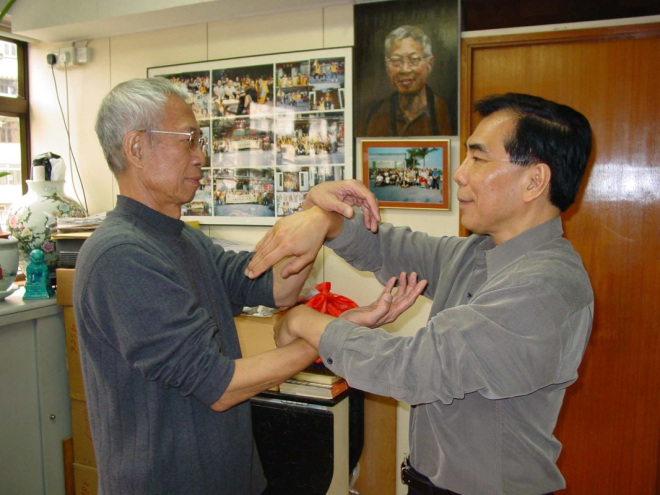
Once the pattern has been memorised and can be performed easily it is time to work on the condition of the arm, a partner will hold the wrist while a move, any of the moves, is performed. The aim here is not to try to affect the partner but to set up a feedback loop to observe how the arm operates against resistance, the thought should be of pushing ourselves away from the partner and not the partner away from us.

Because of the resistance we should be able to identify if we are creating the movement by primarily using our joints or our arm muscles. While in a position of static resistance practice isolating the elbow joint and moving it independently, then practice isolating the shoulder joint and moving that independently and finally combining the use of both of the joints simultaneously.

The awareness should be on the return force created by the resistance to the movement, once this is identified it can be used to check the alignment of the whole body by tracking its passage through the arm into the body and down to the floor.

At first this practice is done with selected, single positions against static resistance, later on the arms move from one position to another for instance Tarn Sau to Chit Sau, the same idea of pushing ourselves and not our partner and allowing the return force to enter into us and pass through us is in play through out the exercise.

It should be easy to see how this progresses into an exercise where both parties can be active, this of course is Chi Sau.

For people that think of Chum Kiu as being a seperate Form any exercises that need a partner should be considered as a Chum Kiu exercise, Chi Sau is a Chum Kiu exercise.

Uncategorized

ABOUT THE FORMS

THE WING CHUN FORMS.

In the beginning there was only one Form in Wing Chun, the Sil Lim Tao, to flatten the learning curve ,for easier digestion and comprehension, this Form was split into three sections, “A”, “B” and “C”.  This was more than likely firstly implemented  by Chan Wah Shun but it became standard practice in the time of Ip Man.

Before long the fact that it was originally three parts of the same Form was forgotten, particularly in Hong Kong this is evident when we look at the Forms from non Ip Man lineages from Malaysia, Vietnam, Taiwan etc {that came about after the dispersal of the Canton Wing Chun Community as a result of the Chinese Civil War and later the Cultural Revolution}.

To this day there is an echo of this practice in how we approach all the other Forms, sections A,B and C.

What the majority of the Wing Chun community now refer to as the Sil Lim Tao is in all reality only the “A”Section of the Sil Lim Tao.  The “B” Section is now referred to as Chum Kiu and the “C” Section is now referred to as Biu Gee.

As a rule Wing Chun does not name specific movements it simply describes them, e.g. Tarn Sau, lay flat hand, Fook Sau, controlling hand, it is contrary to standard practice to suddenly give a name to two of the Forms instead of the usual method of describing their function.

Chum Kiu is a description of the objective that this part of the S.L.T. is working on, namely seeking the Bridge, and with Biu Gee the objective is to unify our Body and Intention, even out to the tips of the fingers.

Not understanding that all six Forms are in fact just different aspects of the Sil Lim Tao, and even worse regarding each of these aspects of the One S.L.T. Form as stand alone Forms not only prevents unification of the IDEA but  leads away from the natural progression down a path that is scattered and often contradictory.

There are complete lineages that base all of their training around just one of these Fragments of Form, it does not matter which Fragments of Form is chosen it is only part of the totality of Wing Chun information.

This is the cause of many of the problems inherent in making the leap from Form to Function, especially in the Ip Man lineage.

The collective information in the Wing Chun Forms is at heart organic, it grows from itself, it is not limited to what is already known, what has already been discovered, in all avenues of human endeavour progress is the result of new previously unthought of combinations of the common building blocks of the base IDEA being realigned, composited.

The “Old Way” is disassembled and then reassembled in a new way that closer reflects todays needs.

New people with different vision see new and different things in the old pattern, new questions bring new answers from the old information.

Tomorrows Wing Chun is only as good as todays questions.

And the first question should always be……….

Does it work?