WE END UP LIKE A BLIND MAN LOOKING FOR A BLACK CAT IN A DARK ROOM WITH NO CATS IN IT.
Hey guys…
… This is a reposting of a very old post, 2019 in fact, but good information never ages badly so it is still a good post.
Chi Sau is a great tool on so many levels but like so many aspects of Wing Chun, if we start of our training not knowing what it is we are hoping to learn there is zero chance of advancing what we know, we end up like a blind man looking for a black cat in a dark room with no cats in it.

Chi Sau is central to the training of Wing Chun but we have a bit of a problem in the fact that it has two different personalities, if we do not understand this the training can move in the wrong direction.
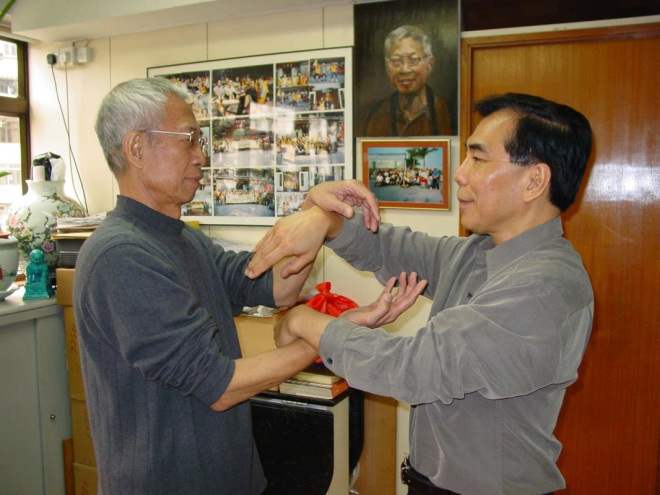
There are two different kinds of CHI SAU, one is a social game of Chi Sau and the other is Chi Sau as a drill for fighting.
At first view they both appear to be the same they use the same structure they use the same actions but where they differ, and they differ severely, is in the training objectives that are being sought through the practice, especially in the area of sensitivity.
In the game of Chi Sau the role of sensitivity is to be able to feel what your partner is about to do before they do it so you can prevent that action, a valuable skill if we wish to stay ahead of the game so it is definitely a sensitivity of what is happening to us, from the outside ,sensitivity of someone else’s body, someone else’s actions other than ourselves.
When were using Chi Sau as a drill for practical applications we need to be using our sensitivity training to monitor what is happening to the FRAME to see where the incoming force is being stuck or is passing through and to be able to feel the shape and alignment of our own body and the actions that we are making.
These two approaches are Chalk and Cheese.
If we try to tackle an opponent and we are thinking of him, trying to work out what he’s doing, instead of taking the initiative then it’s not going to go well for us.
If we are using our training correctly we should only make one defensive contact with our opponent as we simultaneously attack and turn the tables on them, there is no time or need to find out what the Bad Guy is trying to do.
The late Grand Master Chu Shong Tin, my Sigung, once answered a question I asked on Chi Sau by saying ‘the skills we learn in Chi Sau need to be enacted before we make contact’, is brings in to question the idea of sensing our opponent, I can only think that he was talking about practical application and not playing.
All of us play the game of Chi Sau, myself included, and have done since very early on in our training, it is so ingrained that we do not even notice that what we are doing is a million miles away from any reality and when questioned come up with scenarios Hollywood could be proud off.
On occasions I get caught up in the game of Chi Sau when I am rolling, it is hard not to, it is fun, but I soon wake up once I realise that from a practical standpoint I am teaching myself to be in the wrong place at the wrong time making the wrong choice.
The sensitivity in Chi Sau is about being sensitive to the FRAME, making us aware of how our partners actions are making it difficult to maintain the integrity of the FRAME and as such offer us opportunities to regain the FRAME if it has been lost, a valuable skill to acquire.
Understanding the Bad Guy’s intentions is a foregone conclusion, he is trying to hurt us, if we are practicing sensitivity it should be being sensitive to ourselves.
The good news is that all we need to change is our point of view, sometimes though this is harder than learning Chi Sau in the first place, it pays dividends if we can use some drills that are not from Chi Sau, so that we do not get sucked in and start playing, but offer insight to how the FRAME should operate, develop transferable patters that can be used everywhere, even in Chi Sau.
ROLLING BRIDGES.
Chi Sau is Chum Kiu, we seek our partners bridge and then try to roll it away, the seeking of the bridge in Chi Sau is an “Internal aspect”, we seek to place our awareness in our partners bridge, we are not “Externally” pressing our partners bridge, we are not trying to find it.
Think about this for a moment.
If Chi Sau is to prepare us for combat, and if Wing Chun is a “Counter-attacking” martial art we have no need to try to find our opponents arm / strike because it is in the process of finding us, we just wait and meet it.
It can be very difficult to maintain this Internal idea while playing Chi Sau, our Ego wants to get involved and tries to control or manipulate our opponent, we can even engage in a type of sparring through Chi Sau, which if you think about it, and you are honest, is a total contradiction of all Wing Chun theory.
What is the learning objective of Chi Sau?
If Chi Sau is Chum Kiu and Chum Kiu is how we address the moment of contact then Chi Sau is equally about how we address the moment of contact.
In application we would be talking split seconds of active contact and not minutes of rolling.
Make contact – roll away, break contact – punch.
Wing Chun uses chain punching when attacking, or at least relentless striking, so we would make contact and break contact in the blink of an eye.
In training when practising basic Lok Sau, the rolling arms, only one person, partner “A” can be actively involved in a Wing Chun learning objective, the other partner “B” deliberately and purposefully suspends all Wing Chun theories and engages in pushing and applying direct force to “A’s” bridges. In this way “A” can work on how to maintain his shape, his “Body Being”, rolling away “B’s” force and taking the weight into his own body.
“B” is not trying to hit “A” just apply steady pressing {however it is beneficial if the shapes are like strikes}, in this way “A” can experiment using Chum Kiu pivoting and shifting under pressure, observing what happens when you pivot with a Chum Sau, shift sideways with a Tarn Sau or shift back with Jut Sau.
Without presence of mind, constant awareness of the objective, and good supervision this can degenerate rapidly into Arm Wrestling.
Chi Sau is not concerned about moving our opponents arms, this happens as a by-product caused by our own movement, Chi Sau is about developing trust in the fact that we cannot be prevented from moving our own arms any time and anywhere we think fit irrespective of the amount of force presented to them.
This is how we gain confidence in our defensive structures and ideas, this is how we learn.
Another learning objective in Chi Sau is the development of sensitivity.
Sensitivity to what?
I have heard it said that we are gaining the sensitivity to feel what our opponent is intending to do so that we can pre-empt them, even if this was possible it would only be of use when playing Chi Sau when we are rolling for minutes, it would be redundant in the split second of make contact – roll away, break contact – punch which is the reality of what Wing Chun does in combat.
I do wish to be sensitive to my partner, but only in so much that I can be aware of where his weight is coming from so that I can understand what shape I need to be for it to enter my frame and settle in my centre so that I can destroy his stability with my movement, once I have this knowledge tied down and stored away it will become the shape I choose to make contact, mostly I want to be sensitive to myself, to what is happening to my “Body Being” while engaged.
Information is drip fed to us through our Forms, jigsaw pieces dropping at different times for no real reason, my Sifu once told me “this is just where that particular piece of information is stored”, for instance there is an aspect of the Mok Jan Jong that is essential for Chi Sau if we wish to be able to transfer it into a fighting skill, and that is as soon as any resistance is placed on our arm we move away from it, we change our shape, change the relation ship, this is Chi Sau in application. Make contact – roll away, break contact – punch. It may be contained in the fourth Form but most of us are introduced to it when we start Dan Chi Sau as running palms.
Chi Sau allows us to see the full gamut of the Wing Chun defensive idea, we are learning how to defend ourselves equally on both sides of our body and from multiple directions.
Chi Sau rolling is a practice tool that has us deliberately defending with both arms at once, Wing Chun does not do this, in fact we advise against it, so it is not a suggestion for a plan of engagement, it is the exploration of ideas, and like so many of the things we do with both arms a way to maximise our training time.
As popular as it is Chi Sau sparring is a practice to be avoided, if you wish to have a go at each other get it on properly with a partner throwing genuine, random shots at you so that you can identify how everything we do is based in Chi Sau but not Chi Sau.
Chi Sau sparring is defending with two arms and then forcing a strike through your partners bridge, what part of “when the arms are FREE strike through” does this reflect?