
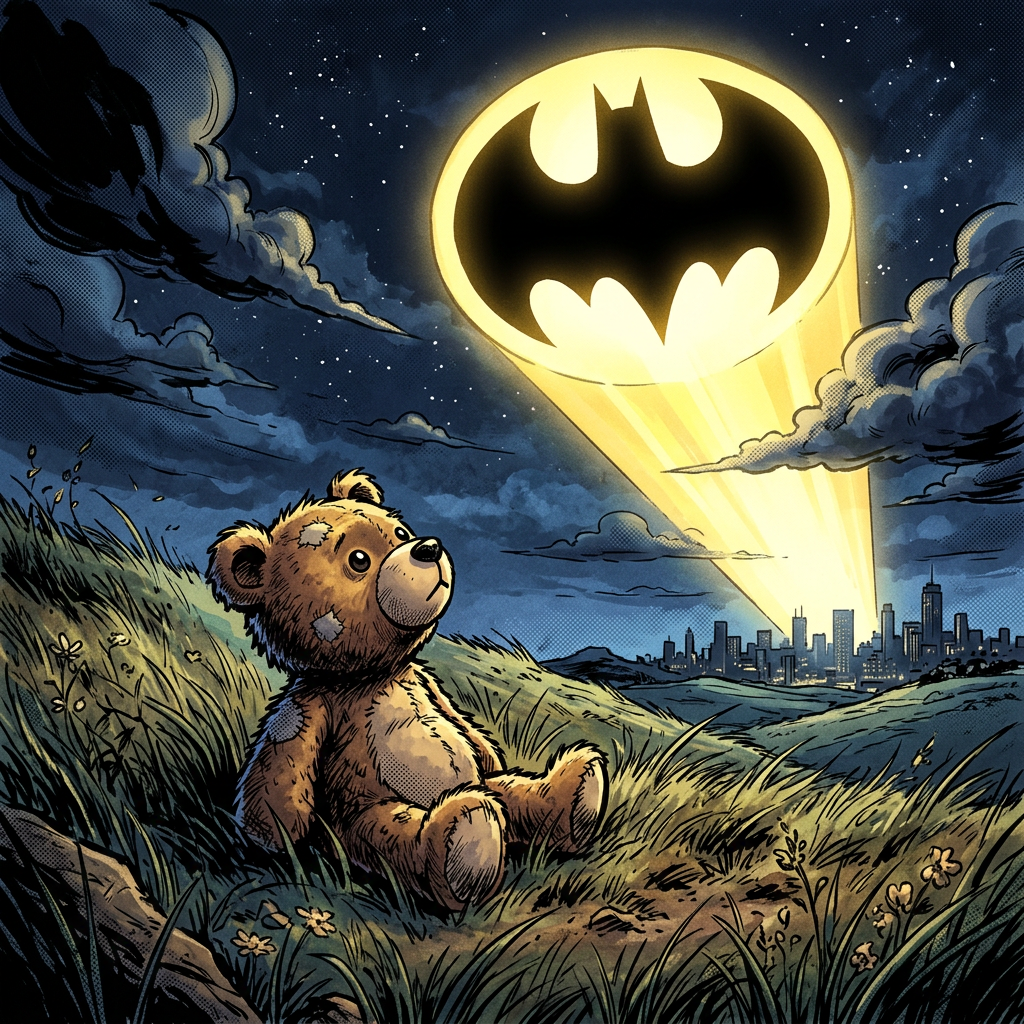
WE NEED OUR OWN PERSONAL VERSION OF A BAT SIGN
I have had numerous conversations with people about what they will do when they find themselves in a violent conflict, and the answer is usually a variation of “I hope my training will kick in”.
What are we saying with this statement? Is this anything close to what we feel, or is it just an unfortunate turn of phrase that we unwittingly buy into?
We are not machines; nothing will “Kick in”. Anything that we HOPE will happen, we need to MAKE happen; we need to DO it.
The “HOPE” statement implies that all of the time and effort we have invested in our training is not only outside of our control, but worse still, is reduced to random chance.
It is almost as if we think that we will not perform the same way in a violent situation as we do in a training situation?
There is a very good reason to think this, but perhaps not the reason we may expect.
Due to the influx of stress hormones, we will be in a physically different body than the one we train in; we will be in a different mindset than the one we train with; and we will be in a different emotional state than the one that does the work.
It is no exaggeration to say that the version of us that will face the conflict will be a different person than the person who has done the training.
We are all familiar with the IDEA that we have many personalities, hence saying such as “I was just not myself” when we do something out of character, or when we “Put on our carpenter’s hat” to do a spot of D.I.Y. Or even the IDEA that we can get in our own way.
Add to that the appearance that we have a different personality with our family than we are with our friends, and different again from the workplace version of ourselves.
We are many, many versions of what we collectively refer to as ourselves.
So the “HOPE” statement is not so much about our training kicking in; it is rather about hoping the better version of ourselves turns up when the day turns nasty, the version of ourselves that has done the work.
Can we increase the chances of this guy turning up when we need him?
Think about this: the person who learned how to drive is a different person than the one who learned to swim, yet somehow, as if by magic, it is not the swimmer who turns up when we get into our car.
When we look at it this way, it becomes clear that to change our answer, and to get rid of the IDEA forever of only hoping to use our training, we need a way for the right version of ourselves to turn up when needed.
We need our own personal version of a BAT SIGN.
The good news is that we already know how to do this; we do it every time the guy who learned to drive turns up when we get into a car.
What is our Wing Chun Training Guy Sign?
What is the switch, key or catalyst that beams down the Wing Chun version of our personality?
It is already there; we activate it every time we step into the training studio, and we activate it every time we do anything relating to Wing Chun.
We do not need to work at making this switch; we simply identify it and learn how to activate it.
As always, it is identified via observation.
We will work on this the next time we are training. Reading about something is not observing it; we need to be in the moment.


 Wing Chun Sydney, Australia