
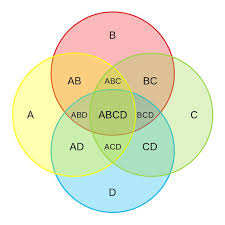
A = SIMPLICITY. B = PRACTICALITY, C = DIRECTNESS, D = ECONOMY OF MOVEMENT.
The Venn diagram above shows how describing simple IDEAS quickly becomes complicated when they interact with each other.
One of the earliest challenges we face when studying Wing Chun is in how we interpret the Fundamental Philosophy or, more accurately, philosophies of Wing Chun.
It is well accepted that Chinese thinking developed along a very different path than Western thinking, I am not implying that either is better than the other because they are so different that we cannot make any relevant comparison, fundamentally the values that informed ancient Chinese thinking are almost diametrically positioned to the values that informed ancient Western thinking.
From the outset, Chinese values have been concerned with the collective, whereas Western values have tended towards individualism.
I often discussed this with my Sifu, {Jim} Fung Chuen Kung, who spoke exceptional English, he would tell me that the best we can hope for is an approximation, and mostly not a very close approximation because when we try to justify or understand Chinese philosophy with Western Ideas we arrive at conclusions that make sense to our thinking, but does not coincide with the original IDEA.
Essentially, Western Wing Chun is a deviation from Chinese Wing Chun. It is still a very good Martial Art, but where we get sidetracked is that in the west, it is a Martial Art with a philosophical side, while originally, it was a philosophy with a Martial side.
When I talk philosophy in Wing Chun, I am talking about …
…a theory or attitude that acts as a guiding principle for behaviour…Oxford English Dictionary
and, of course, measuring everything by itself, by what it is and not by what we think it is or what we want it to be,
And in typical Wing Chun practice, we make it as simple as possible.
Philosophy is always an interpretation; this is the first problem.
The second problem is that, in relation to Wing Chun’s philosophy, it is also a translation.
In my experience, most Western students approach the work as a methodology, which, once developed, they attempt to retrofit with the philosophy, which ultimately leads to overthinking.
If we wish to get as close as possible to the original Wing Chun, it must be clear in our head before it migrates to our hands.
What we are after is acceptance, gained by practice and not belief based on obedience, and then use that understanding to shape our training; this leads to simple, practical, direct thinking.
But what does this mean in plain English?
We should aim to describe the philosophy in simple language, as if to a 7-year-old child, and then see how that compares to what we do.
One of the most obvious misalignments of methodology and philosophy is something that defines Wing Chun.
Counter Attacking.
So let’s begin with that.
Most people, and for a long time, I was part of that most, without realising it drop into methodological thinking when considering Counter Attack.
They immediately think about how to do it or what to do instead of philosophising and asking.
What does counter-attacking mean?
Then, use the answer as a guide.
Something I meant to mention in the video is that from a point of any Martial philosophy when we step towards our opponent, irrelevant of what we think we are doing, we are issuing force, we are attacking, our mindset will be aggressive, and the opposite is also true that any time we retreat from our opponent if we try to evade or avoid, we are defending, and we will adopt a defensive mindset.
In a violent encounter, how we think and how we feel will be by-products of the environment and situation. To a very large extent, they will be beyond our control; how we think affects how we feel, how we feel affects how we think, and they both affect how we act.
Some deep shit right there.

 Wing Chun Sydney, Australia