
All of our knowledge, all of our training and pretty much our only hope is in the ZONE.
There is an obvious contradiction when we try to talk about what we could/should do in a dangerous, violent situation, and then use a safe, non-violent situation, i.e. training, to explore this.
As Sam said at the end of training “It is really just about composure”, and that is bang on the money.
But we must ask ourselves, ‘how can we practice regaining composure in a safe training environment where we are, if nothing else, composed’?
Even a style that uses full-contact sparring has this problem, we can always walk away if we are not having fun.
Believe me, being on the wrong end of a kicking is in no way fun.
Walking away is simply not on the table, running perhaps, but even then we need to engineer our escape.
And to do that we need as much composure as we can muster.
How do we develop composure?
How do we regain composure in a Shit-Fight?
Once regained how do we maintain composure?
No matter which style we train, it is just not possible to come close to the reality of this in training, there is no other choice but to imagine it, to set up scenarios where we can play-act what we think will go down.
This is not as bogus as it may first sound, reality only happens ‘in the moment’, and after that it is stored as memory.
Neuroscientists have shown us that the human brain sees memory and imagination as the same thing.
And all of the ancient wisdom traditions tell us that “We are what we think”.
Since the time of the Stoics in ancient Greece, the philosopher Epictetus told us that how we think changes how we feel, how we feel changes how we think, and that they both affect how we act/ behave.
In today’s psychology, this is the core of Cognitive Behavioural Therapy C.B.T.
As you know I am not a supporter of the notion of “Internal” Kung Fu, by which I refer to the act of generating a force from an unknown origin to power our attacks, to me, is just magical thinking.
But there is, beyond doubt, a non-physical side to training that should not be ignored.
Only a fool would say that fighting/violence is a purely physical experience.
There is a definite emotional aspect and a definite mental aspect, that we simply must find a way to accommodate.
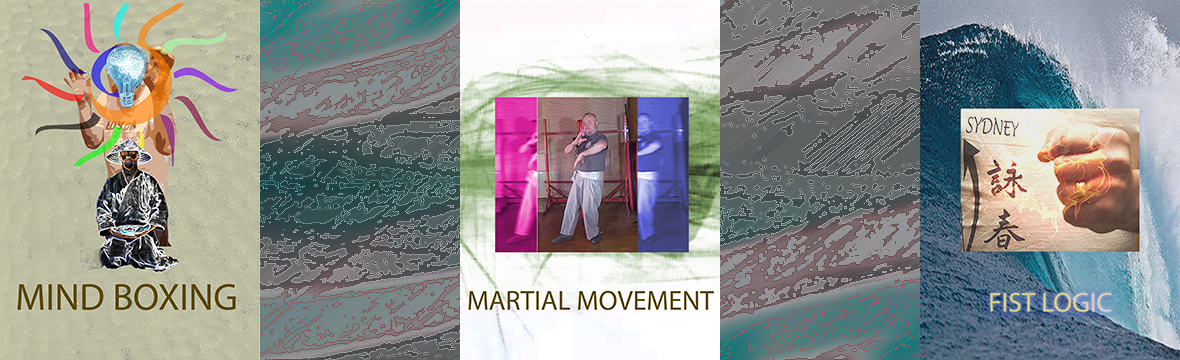
For ease of explanation, I refer to this emotional/mental aspect as “Mind Boxing”
I do not use the term Mind Boxing because I can somehow box with my mind, that is just as bad as any other kind of magical thinking, I call it Mind Boxing because I believe we need to observe, understand, and train our minds as a separate, yet inclusive, part of our {Chinese} Boxing.
I believe this topic to be so important that I have a stand-alone website CLICK HERE.
To paraphrase and contextualise Epictetus…
How we feel in a violent situation will influence how we think in a violent situation.
How we think in a violent situation will influence how we feel in a violent situation.
They will both, in their own way, influence what we do in a violent situation.
It is important to not only accept this but to also understand that the quantity/quality of the effect of how we think and the quantity/quality of the effect of how we feel when under pressure is a sliding scale.
As such no one-size-fits-all solution.
The challenge becomes ‘Can we come up with a generic method that can provide value for all of us’?
We are not alone in this quest, every Elite Sportsman knows this search and luckily for us the Internet is awash with information from Sports Psychologists to aid in eliminating, what in less dangerous environments, might be referred to as ‘performance anxiety’.
To take a leaf from the book of Sports Psychology we need to create a template that we can slip into whenever we need to perform a specific task.
This is where a layman’s understanding of how our Mind works becomes essential to progress.
Everything happening to us ‘in the moment’, all stimuli, are processed by our short-term memory.
The short-term memory is our director, our captain, it calls the shots.
But the short-term memory has minimal storage capacity, by some estimates, short-term memory can only hold around seven items of information at one time.
Anything deemed not mission critical is shunted off into storage, into our long-term memory, where the brain permanently stores the information for future recall when necessary.
How we deal with what is happening right here, right now, right in front of us is the remit of our short-term memory.
But if we get in strife and hope to call on our training we need to access long-term memory.
While we are actively training all of our training information is stored in our short-term memory, but as soon as we leave to go home that info is moved to long-term storage.
When we think about an elite sportsman playing flawlessly, and effortlessly, we say that they are in the ZONE.
Being in the ZONE is being in unobstructed, unfettered contact with our Long-term memory.
How do we access the ZONE when we are in the middle of an active shitstorm?
Because this is more important than anything else.
All of our knowledge, all of our training and pretty much our only hope is in the ZONE.
And as the ‘Brown Becomes Airborne’, we are not.
If we return to the Sports world we see suggestions of setting up cues or triggers, single movements or thoughts that call up complex actions, and complex movements without complex thinking.
If we think about our computers, we click an icon or an alias to open a program.
Addressing the Ball in Golf, preparing to take a penalty in football, waiting for a delivery in cricket, taking a set position in a foot race, and waiting to return serve in tennis are examples many of us will have experience of from school if nothing else.
In these ready positions, the emphasis is as much on setting the tone of our emotions and settling into a pre-trained mindset, only once we are happy that we have adopted these positions do we engage in our trained skill.
Self-Defence Martial Arts are anticipating being surprised, but I think we all know that we cannot expect the unexpected.
The only thing we can expect is some level of surprise/shock.
Do we have any IDEA how to move into and adopt a ready position whilst in a state of surprise/shock?
HOW WE FEEL CHANGES HOW WE THINK.
HOW WE THINK CHANGES HOW WE FEEL.
THEY BOTH CHANGE HOW WE ACT.
EPICTETUS. 130A.D.


 Wing Chun Sydney, Australia