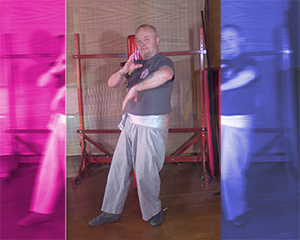
There is little doubt that we do not see the world as it is, we see the world as we perceive it, and this perception, this image, is built up incrementally over the course of our lifetime, it is never set in place and undergoes many reinventions.
As ‘out there’ as it sounds, the easiest way to improve something is simply changing how we see it, which in turn changes its importance. And this cascades into trust and priority, which we may not realise it is the basis of choice.
Last week’s training was mostly about punching, so keeping it in line with this, how do we see/perceive our punch and punching? How and where do we file it away in our ‘Battle Computer’?
I do not remember how many punch variations we worked on but let’s call it four.
Did you perceive this as four separate punches or four variations of the one punch?
Why is this relevant?
Hick’s Law states that the time it takes to make a decision increases logarithmically with the number of choices available. Logarithmically means that every added choice takes longer to make than the previous choice.
Theoretically, deciding which punch to use will take more than four times as long as deciding to just punch, and although we will not consciously compare the variables, we will do it subconsciously.
How we SEE our punch might just be the difference between going home or going to the hospital.
Sticking with ‘PUNCH’ for the moment, what do we punch with?
Are we using a FIST, or are we using a HAND?
I am sure you have a good IDEA of where this is going, depending on how I see my training to hit someone I may need to choose between a punch, a palm strike, a knife hand chop, a slap, a backhand, a hammer fist or a finger poke.
Refer back to Hicks Law to see the problem here.
Without meaning to over-egg the cake, “What are we striking with”?
Hands do not float independently in the air; they are connected to our wrists.
Consider my Sifu’s maxim of “Shoulder pushers Elbow, Elbow pushes Wrist”.
It is possible to get lost in the weeds with this type of regression to a point where we end up thinking that everything is initiated by the collective “BODY”, or if we are hooked on specifics with our Big Toe, so some level of compartmentalism is advised.
“Shoulder pushers Elbow, Elbow pushes Wrist” is, in essence, describing the general mechanics of all of our Hand Strikes, it is the fundamental mechanics of using an ARM.
Again I ask, why is this relevant?
As Martial Artists, we subscribe to the IDEA that it is INTENTION, and not conscious decision-making, that drives the physical application of our Martial skill, this position has been held for as long as there has been Kung Fu and is a central tenet of the work.
Now modern Neuroscience agrees with this age old wisdom, and while Conscious Intentions are formed through deliberate thought and awareness, where you consciously decide on a goal and the steps to achieve it.
They recognise that Unconscious Intentions stem from deeply ingrained habits, unconscious desires, or past experiences, influencing behaviour without conscious awareness. In other words, how we train.
Advances in neurological medical scanners have allowed scientists to observe brain activity, which leads to movement before conscious thought.
Intention happens before we think about doing things.
Realise that it is not about you. Nothing others do is because of you.
Hi Tribe.
This is not a short, read it on the toilet type of posting, this is a mid-length essay, dedicate about 20 minutes, if you make this investment it WILL save you years, so make a coffee, kick out the cat, put your feet up and clear your mind. Or don’t, your call.
SETTLE IN, SETTLE DOWN, BE HERE NOW.
From the outset we must realise that there is no way to talk about the Warrior Mindset, all we can hope for is a way to talk about approaching the Warrior Mindset.We do not seek it out and find it, the Warrior Mindset finds us as a result of our work.
The Warrior Mindset is open to two very different interpretations, a Martial Warrior is a soldier that fights other soldiers, and a Spiritual Warrior is a man that fights the baser elements of himself.Martial Arts conflate these two ideas with very mixed results, mainly due to unrealistic expectations of progress through mystical osmosis.
Martial Arts are the messenger and not the message, but they do provide the tools to translate the message.
Wether we are a Martial Warrior fighting for our lives, or a Spiritual Warriors fighting self ignorance it all hinges on being in the present, the Here and Now, at all times.
Martial Arts provide this by giving us a ritualistic training method, a way of developing singular focus by working hard at performing all of the movements flawlessly, by focusing on what we are doing to the exclusion of all other distractions.It is simpler than it sounds, it could be any movement, any shape done in any way but as human beings repetition and ritual are very powerful aids to success, this is the genesis of all Martial Arts Forms.
There is a great deal of wisdom available to us from such diverse sources as the Toltec Shaman of Mexico, the Buddhism of Tibet, the Egyptian Book of the Dead and of course all of the Martial Art Classics, but there is also new knowledge from more recent travellers on this road from both the military aspect such as Lt. Col. Dave Grossman to the more cerebral approach of Dr. Gavin Becker.
We would profit greatly from visiting more than one library.This essay is intended as an entrée to encourage and entice you to seek out the Grand Buffet.
SETTLE IN, SETTLE DOWN.
Everything begins with Intention, we must know what it is we wish to do, what we hope to find, if we do not know beforehand what we are looking for we will walk right past it when it turns up, as Winston Churchill observed “Men occasionally stumble over the truth, but most of them pick themselves up and hurry off as if nothing had happened.”
CENTRING.
Are we centring our body awareness? Are we centring our mental awareness? Or are we centring our spiritual awareness? Do we even know if there is any difference?
What we seek is what T.S.Elliot referred to as the Still Point of a Moving World.
At the still point of the moving world, there the dance is ……… except for the point, the still point, there would be no dance, and there is only the dance. {Burnt Norton 1935}
BE HERE NOW,
Your breath is always in the here and now, you can’t pay attention to a past breath, and we have no thought of future breath, so if you are paying attention to your breath, you must be in the present.
Breathe in through the nose, a full breathe, hold for a second or three and breathe out through the mouth, breath it all out hold and repeat, and repeat and repeat.
Do not attach importance to the actual breathing, no Wim HofMethod or Pranayama, as wonderful and powerful as these methods are they are intended for different outcomes and could end up both distractive and destructive.
While you breathe observe your breath, feel it, hear it, watch it as it moves through your body like a living thing.What effect does your breath have on different parts of your body, do your shoulders move as you breath?Do they tense? Do they relax?Do they behave the same on Inhalation and exhalation?
Get to know your breath and how every part of your body reacts when you breathe, even down to your toes.Your body is a bellows, feel your chest widen sideways as you inhale and recognise the muscles that do this, then feel it naturally contract as you exhale.
This is not centring, this is just us settling in and settling down, preparing the body and mind for centring.
Centring is a meditation.
The 5 Sounds.
Breathe, settle in and settle down, keep breathing.
Locate and identify a sound that is near you, for instance the sound of your own breathing, listen to it for a short while.
Find a second sound slightly farther away, perhaps a bird, a creaking branch, identify it and place its position in space and notice its relationship to you [orient], is it in front, behind, higher, lower, left, right that kind of thing, listen for a while.Find a third sound even farther out, identify, place, orient, listen patiently. Find a fourth sound even farther out still, identify, place, orient.
For the fifth sound listen right out at the edge of your hearing, it may be just a distant rumbling, listen to it and let it fill the air. Breathe.
Reverse the order of discovery until you are once again at the centre of your personal universe listening to your breathing.
The 5 Feelings.
Breathe, settle in and settle down, keep breathing.
In a purely physical sense feel something affecting your body, it could be the wind on your skin, the sun on your head, your feet pressing the floor, if you are sitting or lying down there are many other possibilities, your shirt collar on your neck in short anything, firstly feel everything separately one at a time, just like the previous exercise feel it, identify its position is space, listen to it.
Feel 5 separate things and then finally feel all 5 things simultaneously.
The 5 Expansions.
Breathe, settle in and settle down, keep breathing.
#1. Close your eyes and see yourself as if from above, see the immediate space around you on all sides, this is well suited to doing indoors sitting down, see the room, see the furniture, breathe easily as you observe the surroundings. Realise that even from here you can still see yourself.
#2. Inhale and expand to a height were you can only see the house that has the room you are sitting in, see the space around the house, trees, cars, neighbours, breathe easily as you observe the surroundings. Realise that even from here you can still see yourself.
#3. Inhale and expand to a height were you can only see the Town/City where your house is, breathe easily as you observe the surroundings. Realise that even from here you can still see yourself.
#4. Inhale and expand to a height were you can only see the country you live in, breathe easily as you observe your surroundings.Realise that even from here you can still see yourself.
#5. Inhale and expand to a height were you can only see the planet Earth from space, breathe easily as you observe your surroundings. Realise that even from here you can still see yourself. At the centre of it all.
The 5 Positions of a Warrior Mindset to apply to the ‘Waking World’.
#1. Measure every decision, every action against the undeniable fact that you are going to die.Maybe not right now, but quite possibly later on today.When measured against our ultimate demise all problems are seen for what they really are and shrink into insignificance.
#2. Do your best. Your best is going to change from minute to minute; it will be different when you are healthy as opposed to when you are sick. Whatever you are doing, simply do your best, and you will avoid self-judgement, and the negativity that goes with it.
#3. Realise that it is not about you. Nothing others do is because of you. What others say and do is a projection of their own reality, their own story. When the actions of others have no importance there is no self doubt. Even in a antagonistic situation it is not about you, a soldier just kills another soldier, not a singular individual person.
#4. Understand the power and greatness of not knowing. All of our problems arise from known things, all of the great answers are as of yet unknown, the things we think we know are the cages that we bind ourselves with. Not knowing is not just a state to be endured; it’s a state of possibility and, a state of power. Creativity is a consequence of not knowing.
#5. Be impeccable. This above all: to thine own self be true, and it must follow, as the night the day, thou canst not then be false to any man. Hamlet Act 1, scene 3, 78–82.
Warriors have an ulterior purpose for their acts which has nothing to do with personal gain. The average man acts only if there is a chance for profit. Warriors act not for profit, but for the spirit.
Using our training to do the work.
Opening up the way to translate the message, how to do the work that will hopefully lead to the Warrior Mindset manifesting.
As I have already mentioned first of all comes INTENTION.
Do we intend to be Martial Warriors or Spiritual Warriors?
The training is the same, so right here right now we do not need to choose, but be assured the final set of stairs are very different.
Let’s make a start, although it is in no way a prerequisite most of the people that will even attempt this work usually have a decent level of basic training, some knowledge of Forms or Kata and a level of understanding about the effort and commitment needed to be competent in the Martial Arts.
Q.Why are we training?
A.Hopefully to develop a Warrior Mindset.
Q.What is training?
A.Training is way to become better, not a chance to prove how good we are.
Think a while on that last statement, “Training is way to become better, not a chance to prove how good we are”.
For a student that has been training for 12 months to a master that has been training for 60 years this statement holds true.
The main aim is to take ourselves out of the equation, to become a witness to the unfolding event and not a participant, only in this way can we respond as opposed to reacting.
This is a life skill, not just a martial skill.
We train Wing Chun so I will use Wing Chun references but it is just a method and could of course be used with any style, any system.
Pick a movement from any of the Wing Chun Forms, just one movement, develop as much knowledge and understanding that you can about this particular movement, get it straight in your head before you attempt to force it on your body.
As Human Beings everything we do is a complete body action, if your Form of choice is the First Form, the S.L.T.Where the only moving parts are your arms, do not make the error of not seeing this as a complete body action.
Stillness and movement are part of a singular continuum, just like sound and silence, hot and cold, they both describe each other, no matter how still my body is my blood and spirit still move.
Let us use the most basic and well known movement, Taan Sau.
As we perform Taan Sau what is the top of our head doing? What is the arch of our foot doing? What is our spine doing?If we happen to be a person who agrees with the idea of circulating energy, what is our Chi doing?
So much to think about, so many body parts to track, so much to be aware of and yet we have not even mentioned the shoulder or the elbow or any other part or aspect of the arm, still we are without doubt talking about Tarn Sau.
It can be any movement from any Form, it is always our whole and complete body, no gaps, no omissions, this in turn creates a condition of singular and concentrated focus that removes us from the world of not doing Wing Chun and drops us squarely into the world of doing Wing Chun.
We are removed from the world of NOT NOW and manifest in the world of ONLY NOW.
Being in the NOW allows us to witness what is happening and make a suitable response instead of just a hopeful reaction.
I will finish with two of my favourite quotes/parables.
Firstly the Taoist Scholar Chuang Tzu. This is a reworking of the Empty Boat Parable, I do not remember where it came from but I really get it.
A man is crossing a river in his skiff in a storm when suddenly another skiff collides with him.He becomes angry and begins to shout until he notices that the skiff is empty, that it has broken its moorings and is loose on the tide.Noticing that the skiff is empty and loose on the tide he stops shouting because there is no one to shout at, suddenly he realises that we are all skiffs in a storm, loose on the tide, and that there is no one to shout.
The second is from the great composer Igor Stravinsky, or quite possibly an Urban myth.
When rehearsing for the upcoming debut of the Firebird Suite, the first violin came to Stravinsky and told him that he was quitting the orchestra because the violin solo was just far too difficult for him to play, Stravinsky laughed and said “of course it is, what I really want is to hear someone of your skill level trying to play it”.
Have you ever heard the term… “I just could not get my head around it”?
What do you think it means?
We have spoke about this many times, essentially it is only what is in our Heads that can come out of our Hands, and of course, this is training.
But what are we putting in our heads? There is a dark side that is always present and often unseen.
I was recently watching a T.V. Show that was set in the late 70s England, at one point a young man was in a situation with three skinheads that turned on him and gave him a sound beating, nothing new there, back then that was pretty normal. But the young man on the wrong end of this thing did nothing to protect or defend himself, he did not even attempt to flee the scene, he just got the shit kicked out of him.
This triggered a memory from my Sifu’s school about 15 or 20 years ago, bear with me on this, it needs a bit of a back story for context.
My Sifu had a very large school, in Sydney alone there were 14 sub-schools, with approximately 50 teaching personnel of varying levels from Branch [Sub-school] leaders, Branch Instructors down to assistant Instructors, even my Sub-School, which averaged around 15 students, had 4 teaching members.
To prevent the school from turning into a complete MacDojo all Instructors needed to attend Wednesday evening training under Sifu’s supervision, and as a Senior Instructor in the School one of my duties was to mentor a certain group of these Instructors on these Wednesday evenings, usually Non-Asians from the branches in the Western Suburbs, which was and is the working class part of Sydney.
Yes, this was racist, but it was not meant to be disrespectful, Sifu had always thought that Westerners thought and processed information differently than Asians, that Westerners preferred hitting things to doing FORMS, and on top of this that people from Western Sydney were an individual sub-set to the rest of Sydney.
In practice, what I did amounted to no more than translating Sifu’s polite words into ‘MACHO’ language and roughening up the edges of Sifu’s descriptions.
This one evening I noticed a small group of guys not exactly getting enjoyment out of the training, so I went and asked if I could help, there was a little bit of indecision, and then one of them piped up “This is not exactly keeping things REAL is it”?
My attempt to persuade them that Forms, especially Chum Kiu, were important fell flat so I asked what they would like to do instead.
Long story short they said they did not know what to do because all we taught them was “Limp Shit that does not work on the street”.
I said “O.K. let’s fix that, attack me and then we will start from there”.
They declined and said it was pointless because as a Senior Instructor I would know what to do and do it easily.
I was a bit lost with this comment, and in hindsight did not make the best choice, I said, fine, I will attack you, and if it fails, we can work from there.
There was a bit of indecision and looking from one to the other, and then one said “Let’s do it, but do what a street thug would do, just do not hurt me”, we all laughed, and I agreed.
I realised I was potentially setting myself up to get ‘regally’ embarrassed and punched in the head, but I had painted myself into a corner.
I decided on starting with a distraction, so I told the guys how I thought I could be biting off more than I could chew, to which they all laughed, and while they were laughing I gave the volunteer a huge double handed push in the chest that sent him flying into the wall, I immediately followed up by grabbing him by the throat and pinning him to the wall while posing a hammer fist with the other hand.
As soon as I grabbed his throat I knew things had gone to shit, the guy just went limp, the colour drained from his face, his eyes became glassy and he offered no defence.
I immediately let go of him and turned to the other guys, asking what had gone wrong, luckily no-one appeared to notice what I had noticed, and the conversation was about how fast it had been and how they had not even seen me move.
I was in my early 50s at the time and told them that it was not that I was fast, this allowed us to steer the conversation into preparedness, distances and awareness.
If it had been a real situation, that young Instructor would have just stood there while I pummelled him unconscious.
I told them that “KEEPING IT REAL’ was more about thinking fast and paying attention, about understanding that this guy you are now talking to is not interested in talking to you, he is trying to slow your mind down, that “KEEPING IT REAL” was to understand that this guy wants to hit you, and if you are close enough he will hit you, and that you may not even see it coming.
Things settled down and we did a bit of work on entering and exiting, on transitioning from defence to attack, and hopefully I demonstrated how the Chum Kiu Form helps us control the distance between the two protagonists.
But what did alarm me was that in the conversation they implied that by teaching advanced defences against complex attacks all we did was paint a picture that the attacker was a skilled and difficult opponent.
I could hear the ‘Dark Side’ softly breathing in the background.
Are we teaching ourselves to be scared, are we failing to see that the Bad Guy never gets any better than he was on our first day of training.
If we do not remind ourselves that we are the ones getting better, we are the ones training and preparing it is so easy to slip towards the DARK SIDE and not even know it.
The BAD GUY will not be getting better because, they are just Arseholes looking for an easy win, they will try to distract and then hit when you are not looking.
Just as I had done to them.
Before they left, they came and thanked me again for the help, I just hope it stuck.
Long story short, one of the most significant things I have become aware of is that we do all of our learning while we sleep.
This post is an intro to what I intend to be a relatively concise and probably long-winded look at the non-physical, intangible aspects of our training.
This stuff is a great deal more difficult to write about than it is to participate in, so do not get put off by this wordy approach.
As you all know my job in the 1980s required me to become familiar with the concepts and practices of “Lateral Thinking”, to the extent that I was sent off to a number of weekend even week-long workshops at the De Bono Institute for Creative Thinking, this in turn started my fascination for how the brain works and how the body interprets the signals.
Long story short, one of the most significant things I have become aware of is that we do all of our learning while we sleep.
Keeping this in mind, everything we learn, practice, train, or develop, be it tangible or intangible, physical or non-physical is a product of A SLEEPING MIND.
This places the whole physical or non-physical argument in a very strange place, but if nothing else shines a light n how important the INTANGIBLE aspects of the work are.
Q1. How often have you said or heard someone else say, “I was in two minds about it”?
Q2. How often have you said or heard someone else say, “ The guy was so Single-Minded”?
Q3. How many MINDS do we have?
It is widely accepted that we only have only one Mind, but I think we all have experienced situations, especially in training, where the mind instructs our body to do things we did not ask it to, in fact, it acts against our interest as if it was a separate mind.
For instance, when I do my party trick of asking you to straighten your Arms, usually standing with your arms folded as in the stance, instead of following the very simple, very clear instructions and straightening your arms, you raise them to shoulder level.
How did this happen?
Our mind double-guesses the situation and decides that what was asked for was to straighten them in front of us.
But that was not what was asked.
This may seem quite trivial, but what would happen if our mind did this in the middle of a violent situation?
OOPS!
This is the realm of what my old Judo Sensei referred to as “Mind Boxing”.
In case anyone finds it odd that a Judo Sensei would refer to ‘Mind Boxing” instead of “Mind Grappling” or whatever, we need to look at a small slice of British social history..
Between the end of W.W.2 and the explosion of Kung Fu cinema in the late 1970s in Britain all Martial Arts styles were regarded as some sort of Boxing.
Hence the Boxer Rebellion in 1900 Hong Kong.
To the rank and file in Britain this how Martial Arts were described, there was…
Roman Boxing or Pugilism which is today’s boxing.
Gentleman’s Boxing, which was the Victorian era Baritsu Fighting system.
Chinese Boxing, which of course was Kung Fu.
Japanese Boxing, which is Karate.
Styles that used their feet were and still are called “Kick Boxing” even though their names say nothing about feet.
In Europe, this was French Kickboxing or Savate.
Even today, the majority of Americans and Australians who have no active involvement in Martial Arts call everything Karate.
So when my Judo Sesei talked of “Mind Boxing” he was not talking about Boxing, in todays way of speaking he would have probably called it ‘Mind Fighting” or perhaps “Mind Martial Art”.
In the late 1960s trying to instruct young “Christian” students in what was essentially Zen Buddhism risked the wrath of angry Catholic mothers or at least an irate local priest.
So, just like my early Sensei, when I talk of “Mind Boxing “, it is simply a label that is used to differentiate between the physical and visible aspects of the work from the purely mental/emotional and intangible aspects of the work.
Understanding this aspect of being human can give us a great advantage over a Bad Guy who does not understand this.
Hey Tribe.
Sam and I were going over some things we aim to bring to the fore in the coming few months, I am sure you can see that we had a hoot doing it, even if it is super serious.
We all take our ability to maintain balance for granted because to a very large extent it is not us that does the work, not consciously at any rate, it is an automatic background task that gets applied by a separate program than our everyday “I am Groot” Mind. mind.
On one level we all know this, but not the level that does Wing Chun.
Understanding this aspect of being human can give us a great advantage over a Bad Guy who does not understand this.
There are aspects of Boyd’s O.O.D.A. Loop at play here, and we will cover this during the work.
We need a method to train how to activate our previously “established” Chi Sau training in Sparring sessions. Or, we will just be dancing.
In any Martial Art, there is a well-established path from basic training to actual engagement, these “Core Ideas” separate one style from another.
This progression works along the lines of physical conditioning → coordination drills → combat technique → force-on-force sparring and then engagement.
Wing Chun is no different in its approach, the progression is the same just the type of content differs.
Our FORMS act as conditioning and basic coordination; we also have combat techniques, and then we have Chi Sau, which is as close as we come to force-on-force sparring.
But Chi Sau is far more complex than just sparring, Chi Sau is both a training vehicle and a sparring vehicle, which can cause problems and misunderstanding.
Training and Sparring are very different animals to the extent that Sparring is of very little value as a training vehicle, just as we are too busy to be thinking about training while sparring.
As a training vehicle Chi Sau teaches coordination, combat techniques, and physical conditioning, but of real interest, it teaches how to dynamically accept force.
Sparring is where we use what we have learned through training.
We need a method to train how to activate our previously “established“ Chi Sau training in Sparring sessions. Or, we will just be dancing, and learn very little regarding engagement.
Wing Chun is a very intelligent system so it should be no surprise that we do have such a method, if we know where to look for it, and how to access it.
Enter the Mok Jan Jong, the Wooden Man.
Like so much of our training, there are many layers or levels of understanding to every component of our system, how we approach or work on the Wooden Man is far more important than what we do with it, this is the “Concept” aspect of the work.
When playing on the Dummy, what “Concept” are we trying to realise?
This is not as complex as it may sound, after all, the main IDEA behind Wing Chun is simplicity.
So what are we doing here, are we trying to realise attacking concepts are we trying to realise defending concepts, or are we exploring our Chi Sau?
The Wooden Man is nothing more than a training partner, so are we playing, sparring or training?
For the context of this post, we are exploring Chi Sau with our Wooden Man.
From this perspective, when working on the dummy pay special attention to the rotations that occur when moving into contact, at contact and through contact with the Dummy Arms.
This is SO very important, in fact, I recommend exaggerating the amount of rotation that you are using to illuminate that there is natural rotation in every move.
Once we reach a stage where through practised repetition we have internalised and habitualised rotating into, through, and out of contact it will naturally become how we make contact with everything we interact with.
It is this rotation that constantly compromises our attacker/partner’s balance.
If we are at a stage where we practise our FORMS with freedom of movement, going more with feeling than shape and pattern, and here as well it does not hurt to exaggerate the movements; we are adding more and more complex rotations to everything we do.
Bringing both of these practices into our Chi Sau allows us to get comfortable with doing them in a semi-dynamic environment, that transfers well to free play, and of course free play is a precursor to genuine engagement with an attacker.
Once we become comfortable with this type of work it becomes clear that this type of engagement keeps our attacker/partner permanently off balance and in a weakened position.
No man ever steps in the same river twice, for it’s not the same river and he’s not the same man. Heraclitus.
This time of year is traditionally a time of reflection; we compare where we are at in this moment compared to a previous time, such as last year.
How we measure this comparison sets up the training goals going forward.
In my own experience, this is reflected in Wing Chun becoming smaller and simpler; it has been at least twenty years since I learnt anything that could be regarded as “NEW”, but the understanding and appreciation of these things I have known for years continuous to grow deeper and more profound.
But just like everyone else I still need a plan going forward or all of my gains will cease to exist.
Use it or lose it.
If, like most of us lot, you have been training for more than 10 years, in which time even if you are unaware of it you have been shown everything that there is to know about Wing Chun, the emphasis should be on refining what you think you know, reducing the content, trying to identify a common denominator, and then polishing it until it shines like the Sun.
So where do we look and how do we make it interesting and not just more of the same?
Something that fascinates me is the progress in Human-like robots, and there is a shit-tonne of info on the web, especially VIDEO, that we can access.
After all, isn’t that what we are doing with Kung Fu, trying to make a perfect human?
When I watch videos of the latest robots, the thing that impresses me most is their ability to keep Balance and Stability, even when being hit with a stick. It is pretty scary how good they are becoming.
We could do much worse than starting there.
First of all, let us be sure that we are talking about the same things, at least in the context of this post.
Balance is the ability to remain uptight working against no outside force other than gravity.
Our weight is evenly distributed, and our spine is vertical.
Our body is aligned or “stacked’ in such a way that it is self-supporting and not held in place by using added physical strength to maintain it.
Stability is the quality of being unchanging.
From our Wing Chun perspective, this is especially the physical condition or feeling of self, what we refer to as “Body Being”, and to a certain extent the shapes we adopt when moving.
Moving requires muscular effort, therefore, if we are moving, we are not in balance, counter-intuitively, this means that we are only in balance if we are still.
In the context of Wing Chun, where we constantly aim to minimise muscular tension, the implication is that the stiller we are, the closer to optimal we are, this is reflected in the principles of “Economy of Movement”, and “Minimal use of Brute Force”.
It should be quite obvious that being still is not the optimum position to defend ourselves from, but the theory is correct.
What we need is to establish a “Sliding Scale” with uninhibited free movement at one end and stillness at the other.
In a situation like this our training becomes more about this sliding scale used on our current knowledge than learning some IDEAL Wing Chun.
Training becomes about working with what we have and finding our personal “Goldilocks Zone”.
The way this Robot moves is the optimum way for a bipedal creature to move, and it looks like Chum Kiu.
It is clear that if we cannot stand up we cannot defend ourselves.
We cannot hope to achieve optimum Wing Chun without optimum Balance and stability.
Richard asked if I could put a post up to cover as much of Chum Kiu as I could, I am pretty sure it will be of use to a few of you.
First off, when listening to anyone about any Form from any style stay aware of the fact that a Form is nothing more than a structural framework that allows the concepts to be laid out in a way that makes sense to the right person at the right time.
In due course we will all interpret the information [any Form] in a way that fits the way we think and compliments the way we move.
Remain mentally flexible.
Let’s get to it.
What is the best way to approach Chum Kiu?
We can approach Chum Kiu in as many ways as we can think up, it can be super simple such as “How many new moves are the in Chum Kiu that I need to understand”?
The answer to this is just 2?!
Pivoting and Shifting.
Or we can dig deep into every nuanced interpretation and now there are millions of ways.
The best is, as with everything, start small and grow, from the super simple to the insanely complex.
It is your journey and your choice.
CHUM KIU- A CLOSER BRIDGE.
There are some personal picks from the archive below that will help your journey and save you making a detour into the past posts department.
FROM THE ARCHIVE.
Here are some earlier posts that will help with the work and the training of the aspects we explore with Chum Kiu.
I recommend reading the text to the posts as it sometimes adds clarity to the context of the video, but if you are stuck for time, as we all are, just watch the vids.
If one moves they all move if one stops they all stop.
The most famous maxim in Real Estate is “Location, Location, Location”, the implication being that substance can be developed or improved later, in fact things can be demolished and rebuilt if the “Ground” we chose was fit for purpose.
In every style of Martial Arts this “Ground”, is the fundamentals of Self-control, the “Basics” of Human movement…
Balance, Stability and co-ordination.
Once developed this understanding is reinforced by an individual styles structure and philosophy.
It is one of life’s most curious enigmas that the people that would benefit the most from studying these basics tend to rush past them in pursuit of the so called advanced methods, ignoring older information for something newer without first reading the older information that they so obviously birthed from.
The stats for this blog tell me that very few visitors use the menu bar to explore what ,as the author of this blog, I think are the “Jewels in the Crown”.
Here is one of the posts that live in the Structure/Frame dropdown menu, this information is so central to everything else we do it could be used instead of standard training.
Balance and Stability:
Keeping it simple Balance is maintaining equilibrium when motionless against nothing but the Force of Gravity.
Balance is motionless, if we are moving it is more accurate to talk about Stability.
Stability is maintaining or regaining Balance against outside forces, including forces created by ourselves, as in our own movement.
Balance is motionless and Stability is maintaining or regaining Balance, therefore Stability is about remaining or becoming still.
Some confusion arises because frequently Stability is referred to as either Static Balance or Dynamic Balance, especially if we include coordination, in this context :
Static Balance refers to the ability to maintain the body’s centre of mass within its base of support, as in standing still.
Dynamic Balance refers to the ability to move the centre of mass outside the body’s base of support, while maintaining postural control as in moving.
Balance and Coordination.
Dynamic Balance is the ability to stay upright or maintain control of body movement, and Coordination is the ability to move two or more body parts under this control, smoothly and efficiently.
As always the best approach is to do your own research and form your own opinion.
Three important principals of Balance / Stability.
A broader base of support {wider feet} increases stability.
Keeping the line of gravity central inside the support base increases stability.
A lower centre of gravity increases stability.
From a Wing Chun perspective, the lower stances / positions of the Chum Kiu and Baat Cham do are more Stable than the higher stance / position of the First Form {S.L.T}.
Getting back to the previous statement that “Balance is motionless and Stability is maintaining or regaining Balance”, it is more useful to think that Stability is about remaining or becoming still, we can see that the movements activated through the various Wing Chun Forms are not so much about moving to or from an opponent but rather moving from one position of equilibrium to another, moving to a new position of Stability, they are about stopping.
This is an important factor in power production and in keeping with the Conservation of Momentum Theory.
If we use the Chum Kiu Form as our testing ground the cycle of movements should go from being still {Static Balance} through the sequence or movement of choice, for instance the lateral shifting with Dai Sau and Bong sau {Dynamic Balance} culminating in stillness at the completion of the sequence or movement {back to Static Balance}.
The movement of the arms adds extra complexity to maintaining Balance by introducing new vectors but the main take away for the arms is in developing coordination of the upper and lower body, the action should fill the same time period, both stopping and starting,as the movement of the legs and waist.
If one moves they all move if one stops they all stop.
The Wing Chun Forms are subtle and use minimal movement deliberately, because of this it can be difficult to observe the movements in detail, it is often easier and more effective to have stand alone exercises to study this, once we are familiar with the connections between Balance, Stability, Coordination and Movement the understanding can be transposed onto the various Forms.